

The Puzzle of Snowflakes: Treatments May Be Uniform, But Patients Are Not

Julianna Paradisi blogs at JParadisi RN; her artwork appeared on the cover of the October 2009 issue of AJN, and her essay, “The Wisdom of Nursery Rhymes,” is upcoming in the February issue.
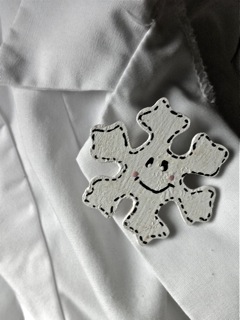
My patient sits in a chair, watching a DVD presentation about caring for his new, surgically inserted, tunneled catheter. In a few weeks, this catheter will be used for his stem cell transplant. I am teaching him how to flush it and change the dressing. He’s from out in the sticks, too far away from the clinic for our nursing staff to provide the care for him. He doesn’t have family or friends for support. After the DVD, I bring out a chest manikin and dressing kit to demonstrate the sterile dressing change. As I explain the technique of donning sterile gloves, he stops me with a challenging glare.

“I can’t do sterile.”

I stop what I’m doing to explain the dangers of infection if the dressing isn’t sterile. Like a car stuck in a snowdrift, he remains unbudged. “I can’t do sterile,” he insists. I puzzle over what to say next. My coworkers flurry by in their white lab coats. I’m wearing a white lab coat, too. My patient is lost in a health care blizzard. He doesn’t see snowflakes. He only sees snow.

‘The Birthplace’: Showcasing a Collaborative Practice Model

By Sylvia Foley, AJN senior editor

Photojournalist Alice E. Proujansky reports in AJN this month on The Birthplace, a collaborative care practice model at Baystate Franklin Medical Center in Greenfield, Massachusetts, where a team of five nurse midwives, three obstetricians, and 35 nurses attend some 400 to 500 births annually. Except for preterm and other higher-risk deliveries, the nurse midwives manage all deliveries and monitor fetal and maternal health. Patients complete detailed birth plans that afford them various care options. Physicians are called in only when necessary; as one nurse midwife told the author, “There’s an awful lot that we can do on our own.”

How well does the model work? The Birthplace has lower-than-usual rates of medical interventions such as episiotomy, epidoral anesthesia, and cesarean section. The patients have greater autonomy and decision-making capabilities. And the practitioners “relish the collaborative approach,” says Proujansky, who interviewed several clinicians and patients for the article; her photographs appear alongside the text and on the December cover. Proujansky’s last piece for AJN, a photo essay on a Dominican maternity ward, appeared in our December 2008 issue; read it here.


Bookmark and Share

2016-11-21T13:14:38-05:00December 21st, 2010|Nursing, patient engagement|0 Comments

‘At the Night Camp’: How Assumptions About Patients Can Blind Us

The entire time he was with us he kept looking around, eyes darting back and forth and toward the truck he’d driven, which he told me wasn’t his own. He shifted uneasily in his chair, and I felt the impulse to try to comfort him and tell him we could help.

That’s an excerpt from “At the Night Camp,” the December Reflections essay in AJN. The essay, by Meg Sniderman, a student in the MSN program at Emory University School of Nursing in Atlanta, takes a wry, honest look at the ways we can imagine whole lives for those around us based on their cultural identifiers, yet often miss the most obvious things about these patients . . . the things that make them just like us, despite apparently vast cultural differences.—JM, senior editor/blog editor

Bookmark and Share

Turkey, Sweet Potatoes, and Living Wills

By Christine Moffa, MS, RN, AJN clinical editor

When I was growing up, my family spent Thanksgiving dinner at my grandmother’s house. She was a star in the kitchen, with cooking and baking skills beyond compare. However, while she made a chocolate cream pie to kill for, her knack for turning every conversation into a newsfeed of various neighbors’ illnesses, symptoms, and near-death experiences, if not actual deaths, stood out more. She did this so much that my brother began referring to her as Grandma Kevorkian.

It turns out that death-and-dying discussions on Thanksgiving might not be such a bad thing, according to Engage with Grace, a nonprofit organization that promotes end-of-life discussions. In 2008 they launched a blog rally timed with Thanksgiving weekend, for bloggers to get the word out about end-of-life discussions. The idea is to have the conversation when most of the family members are together, and the Thanksgiving holiday is a perfect fit. There’s a five-question tool available on the site that can be used as a conversation starter, as well as other resources.

While talking about these topics could potentially clear a room, it’s a lot worse to be sitting at a family member’s bedside in the ICU and not knowing what to choose for them because they didn’t let you know in advance.

For additional information on end-of-life discussions and options, see the AJN articles “Life-Support Interventions at the End of Life: Unintended Consequences,” by […]

Anti-Antibiotics Week

Not only is antibiotic resistance dangerous and expensive, it’s on the rise. Unfortunately cold and flu season can make people so uncomfortable they’ll do anything to feel better, including insisting their health care provider write a prescription for a medication that can’t help them. In an effort to change this, the CDC and FDA have teamed up for the 3rd annual Get Smart about Antibiotics Week (November 15–21).

Go to Top