

Nurses spend more time with patients than most other types of providers and have unique insight into patient care and the the healthcare system.

A Focus on Meaning and Attitude: This Week’s Nursing Blog Post Suggestions

By Jacob Molyneux, AJN senior editor

'Autumn Washed Away,' Diane Hammond/ via Flickr ‘Autumn Washed Away,’ Diane Hammond/ via Flickr

Here are a few recent posts by nurses that you might find of interest. As I put this together, a theme emerged, so it seemed fair to just go with it. Maybe the approach of these bloggers has to do with the time of year, the shorter days and colder weather as we approach the winter holidays . . .

At the intriguingly titled Nursing Notes of Discord blog, there’s a short reminder post with a fairly straightforward descriptive title: “Anyone Can Make a Positive Difference.” And, the author points out, you “don’t even have to be a nurse” to do so.

At Digital Doorway, Nurse Keith has a recent post that also focuses on positivity, this time about one’s profession: “For Nurses, ‘Just’ Is a Four-Letter Word.”

At HospiceDiary.org, in the lovely post “Leaves, Geese and Other Ramblings”—as the below quote may suggest—we find another angle on this theme of being present and focusing on the good in the midst of sometimes constant, poignant awareness of change, loss, dying, and rebirth:

A Report from the ANA Safe Staffing Conference

Katheren Koehn, MA, RN, AJN editorial board member and executive director of MNORN (Minnesota Organization of Registered Nurses), reports from last week’s ANA conference on staffing held in Washington, DC.

staffiing Click image for source page at ANA staffing site.

The ANA Safe Staffing Conference ended on Saturday. There were almost 700 registered nurses from all over the country in attendance—nurses in management, direct care, and leadership—all gathered to try to discover new strategies for how to solve the most challenging issue in nursing: safe staffing.

Not a new issue. This has long been the most challenging issue for nursing. Teresa Stone, editor of Poems from the Heart of Nursing: Selected Poems from the American Journal of Nursing, told me that, as she was searching the archives of 113 years of AJN issues for her book, she found that staffing issues were a frequent theme. Today, as the work of nurses has become more complex, the need to create sustainable solutions to ensuring appropriate staffing is our most critical issue—hence the ANA Staffing Conference.

The body of evidence supporting the idea that appropriate nurse staffing makes a difference in saving patients’ lives has grown exponentially in the past 20 years. This evidence—paired with the new federal financial incentives for hospitals to improve patient outcomes and experiences—makes it seem inevitable that increasing nurse staffing would be […]

‘Spread the Word, Not the Germs’ – Infection Control During Religious Gatherings

By Shawn Kennedy, MA, RN, AJN editor-in-chief

Last week there was a disconcerting report from the Associated Press about a Catholic clergyman in North Dakota who may have inadvertently exposed many members of his church to hepatitis A. According to the report, the ill bishop had probably contracted the illness from contaminated food while attending a conference in Italy and, because he didn’t immediately feel ill (incubation period usually ranges from two to four weeks, though can be as long as eight weeks), continued to dispense communion at several area churches.

According to the Centers for Disease Control and Prevention (CDC) Web page for hepatitis A, infection “is primarily transmitted by the fecal–oral route, by either person-to-person contact or consumption of contaminated food or water.” A person is infectious from two weeks before to one week after the onset of symptoms. The FAQ page on the site does say, in regards to infected food handlers (which would seem to fit this case, in that the bishop handled communion hosts), that “transmission to patrons is unlikely”—and also offers some guidance for postexposure prophylaxis (PEP). In this case, too much time had elapsed: PEP needs to be given within two weeks of exposure.

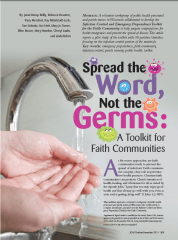
SpreadTheWordNottheGermsOpeningSpreadScreenshotThis situation made me wonder, though, as we’re about to enter peak flu season, if there are any infection control guidelines appropriate for religious services. Some […]

Measuring Dyspnea Upon Unit Admission: Is It Feasible?

Do You Ask Your Patients about Dyspnea?

Photo by Thomas Northcut. Photo by Thomas Northcut.

As a CE article this month, we feature a report of a pilot study on routine assessment of dyspnea on admission to a patient unit. It’s routine to take vital signs on all patients on admission, but really, how many nurses actually stand there and count respirations for all patients? And even if you are the exceptional nurse who does, that doesn’t necessarily tell you if the patient actually feels any shortness of breath. And then, of course, there’s the issue of whether it’s a good idea to add to the burden of documentation that many nurses are already concerned about.

This article reports on one group’s experience piloting a short dyspnea assessment tool for all admissions on several units. Here’s the abstract:

The assessment of dyspnea, like that of pain, depends on patient self-report. Expert consensus panels have called for dyspnea to be measured quantitatively and documented on a routine basis, as is the practice with pain. But little information is available on how to measure and record dyspnea ratings systematically. Consequently, the prevalence of dyspnea in hospital settings may be greater than is generally recognized, and dyspnea may be insufficiently managed. This article describes a pilot study that sought to test the feasibility of measuring dyspnea as part of the initial patient assessment performed by […]

Tightly Scripted: One NP’s Experience with Retail Clinics

By Karen Roush, MS, RN, FNP-C, AJN clinical managing editor

Retail health clinics (walk-in clinics that are in a retail setting such as a drugstore or discount department store)KarenRoush have become an effective mode of providing increased access to care for many people and a growing source of employment for nurse practitioners (NPs). Their place in the health care arena may take on even more significance as the Affordable Care Act (ACA) increases access to care for previously uninsured people.

I worked as an NP in a retail clinic for about six months while working on my PhD. I left because of concerns I had about the model of practice. It didn’t have to do with the fact that I had to mop the floor at closing time or collect the fees and cash out the “drawer” every night. Nor because I spent eight hours alone in a small windowless room tucked away in the back of a drugstore. Those aspects were not great, but they weren’t deal breakers.

What was a deal breaker was the rigid programming of my practice. The computer was in control. From the moment the patient checked in at the kiosk outside my door, every action was determined by the computer.

The organization I worked for prided itself on following evidence-based […]

2016-11-21T13:06:09-05:00November 1st, 2013|career, nursing perspective|2 Comments
Go to Top