

About Jacob Molyneux, senior editor/blog editor

Senior editor, American Journal of Nursing; editor of AJN Off the Charts.

When Your Child Has a Scary Chronic Illness

By Jacob Molyneux, senior editor

It may be easier to live with a chronic illness than to have a child who has one. The June Reflections essay, “Seized,” is by a mother who eloquently evokes her struggle to accept her daughter’s epilepsy. She honestly confronts her own resistance to letting her daughter be a normal child—despite the terrifying episodes, the sense of helplessness she feels as a parent, the wish that she could always protect her daughter.

Here’s how it begins, but I hope you’ll click the link and read the entire essay.

It begins with a gurgle from deep in Daney’s throat: low, primal, guttural. In the next few seconds, her back will arch and her palms will turn up. Her 10-year-old self will twitch, then tremble, like she’s being electrocuted—and in a way, she is.


Bookmark and Share

A ‘Ruined Generation of Men,’ Plus a New Class Divide? Digital Adverse Effects in the News

By Michael Fergenson, AJN senior editorial coordinator

LAN Party NW, 2009/Chase N., via Flickr

There continue to be questions raised about the harmful effects of the excessive use of digital devices, mostly in the young but also in adults. Such ills as ADHD, violence, poor school performance, social isolation, and bullying have been attributed to the overuse of gaming, the Internet, and social media Web sites.

A ruined generation of men? Psychologist Phillip Zimbardo, well known for his ethically borderline 1971 Stanford Prison Experiment, contends that video games and digital media do have a detrimental effect on today’s youth, especially males. His recent article, “The Demise of Guys: How Video Games and Porn Are Ruining a Generation,” argues that addiction to video games and online porn “is creating a generation of risk-averse guys who are unable (and unwilling) to navigate the complexities and risks inherent to real-life relationships, school and employment.”

He refers to stories such as a South Korean man who went into cardiac arrest after playing a video game for 50 hours straight, a man whose wife kicked him out because he couldn’t stop watching porn, and a mass murder suspect who claims to have used video games to prepare for his crime of shooting 77 people. Zimbardo argues there may be a link between violent video games and real-life aggression.

Causation is hard to prove, but many studies have pointed to negative physiologic and psychosocial effects of such games over […]

A Decidedly Female Focus: June Highlights

By Maureen Shawn Kennedy, MA, RN, AJN editor-in-chief

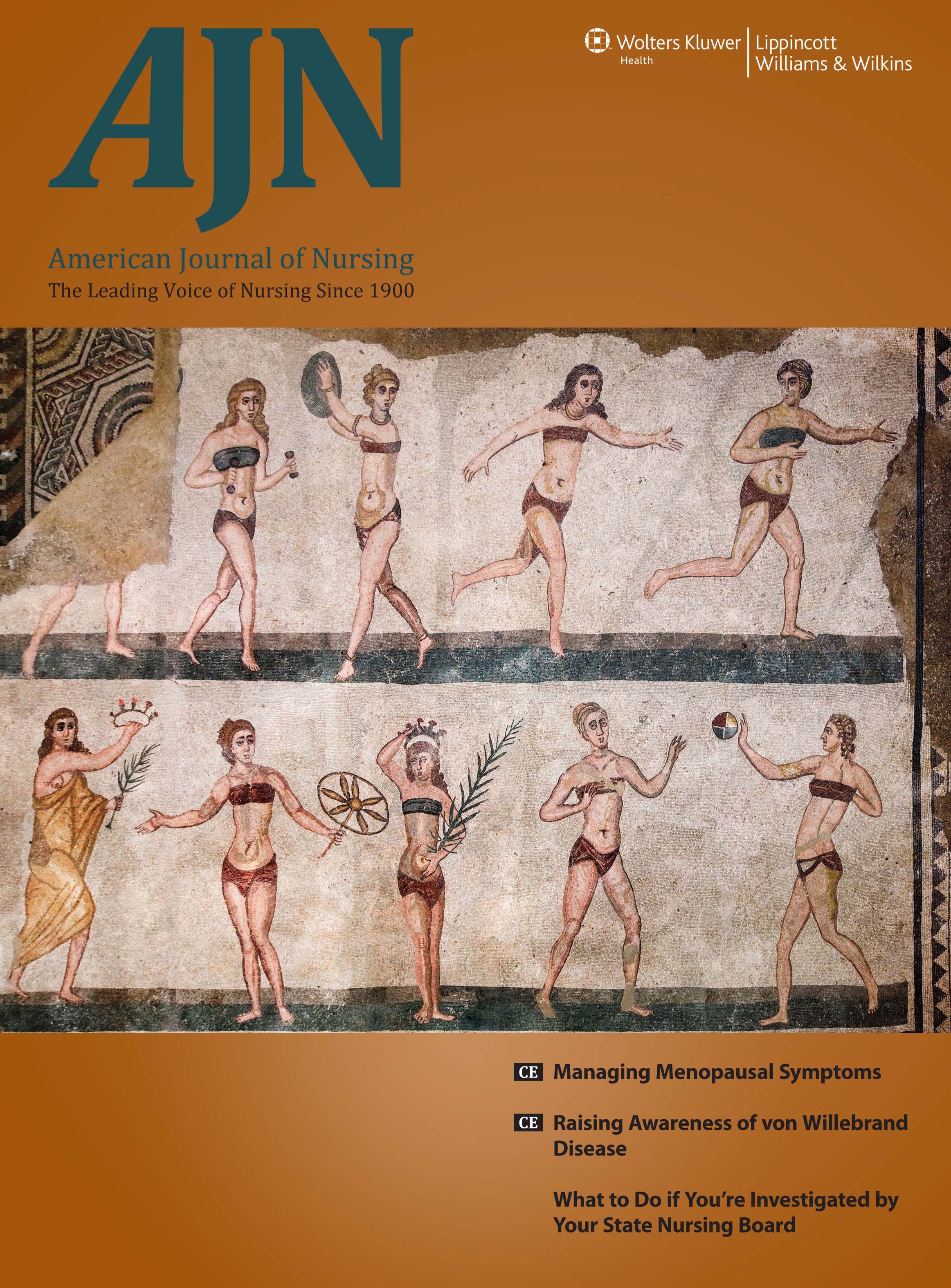
This month’s issue of AJN has a decidedly female focus, from the cover to the last page.

On the cover, we used an illustration of ancient Roman mosaics depicting women exercising.

The editorial focuses on the politicization of women’s health issues. (Read it and see if you agree—we’ve already received both pro and con letters.)

AJN Reports discusses safety issues connected with the often unregulated sharing of breast milk among women via Internet-enabled sale or donation.

The two CE offerings focus on women’s health: “Managing Menopausal Symptoms” is the third in our series on women’s health and provides an overview of managing a few of the more common and troublesome menopausal “changes”—for the sake of historical perspective, we included an archival piece from 1910, “Dangers of the Menopause” (abstract only; archival articles require a subscription).

The other CE, “Just Heavy Menses or Something More? Raising Awareness of von Willebrand Disease,” takes a detailed look at an inherited bleeding disorder that afflicts equal numbers of men and women. While much of the article’s information on the disorder and its recognition and management is relevant for both sexes, the article draws particular attention to women who are often not diagnosed because the disorder may present through symptoms associated with a woman’s menstruation pattern.

Lastly, “Seized,” our moving Reflections essay this month, tells the story of a mother’s  feeling of powerlessness in the face of her daughter’s […]

What to Do If the Nursing Board Takes Action Against You: A Lawyer and Former RN Advises

At 7 AM, when RN Michelle Flacco took over the care of 66-year-old Lester Scanlon, who had dementia and type 1 diabetes, she was notified that his blood glucose level was significantly elevated, at greater than 550 mg/dL. Ms. Flacco performed blood glucose tests three times during her shift, each time after Mr. Scanlon had eaten a meal, and each time his blood glucose level was elevated. However, Ms. Flacco didn’t notify Mr. Scanlon’s physician, nor did she administer insulin to the patient. The next shift, Mr. Scanlon was found unresponsive, with a very elevated blood glucose level. He was diagnosed with diabetic coma. The incident was reported to Ms. Flacco’s state board of nursing, and she was accused of professional incompetence. The board is seeking revocation of her RN license.

That’s the opening of “You’re Being Investigated by Your State Nursing Board” in the June issue of AJN. The case described is a composite, but it illustrates a situation that a nurse can find herself or himself in. The article, currently open access, is by Margaret E. Mangin, who practiced nursing for 12 years before becoming an attorney. For the past 26 years, she has practiced law in San Diego, primarily defending hospitals, nurses, and other health care providers. This is the latest installment of our Legal Clinic column. You might want to check it out. The table below gives the most frequent licensing violations, 1996 to 2006.

Big Changes for New York Nurses

By Shawn Kennedy, AJN editor-in-chief

On Thursday, May 17, the New York State Nurses Association (NYSNA) held a special members-only meeting at New York City’s Jacob Javits Center to vote on bylaw changes that will drastically alter the future of the organization, morphing it from a professional association into a union. One of the key changes had to do with who could hold office in the organization: going forward, only bedside nurses, retirees, and “non-statutory” supervisors (i.e., those not able to hire or fire employees) would be eligible for office.

Other changes include eliminating the position of CEO and changing it to that of executive director, in order “to better reflect the union’s democratic roots and greater accountability to working nurses,” and a decision to push for nurse–patient staffing ratio legislation in the next session.

The NYSNA, which with 37,000 members, was founded in 1901 and is the oldest state nursing association in the country. Until January, when it was suspended for one year, it was the largest constituent member association of the ANA.

According to ANA documents, the NYSNA violated ANA bylaws by engaging in “dual unionism” when its newly elected board of directors replaced the CEO with Julie Pinkham, who is also the executive director of the Massachusetts Nurses Association (MNA). The MNA had disaffiliated from ANA in the past, along with the California Nurses Association, and were founding members of National Nurses United. The ANA […]

Go to Top