

About Jacob Molyneux, senior editor/blog editor

Senior editor, American Journal of Nursing; editor of AJN Off the Charts.

Top 15 American Journal of Nursing Blog Posts in 2013

Blogging - What Jolly Fun/Mike Licht, NotionsCapital.com, via Flickr Creative Commons Blogging – What Jolly Fun/Mike Licht, NotionsCapital.com, via Flickr Creative Commons

In keeping with journalistic custom, here’s an end-of-year list of the most popular 15 blog posts on Off the Charts in 2013. Some were new posts this year. Some were from previous years but are still as relevant as ever. We’d like to think not everything that appears on this blog is ephemeral. Thank you to all our excellent writers and thoughtful readers. Cheers!—Jacob Molyneux, senior editor/blog editor

 1. “The Heart of a Nurse”
“As nurses, we are drawn to the field for many different reasons. What is exciting and fulfilling to some is stressful and boring to others. Our ability to show compassion is perhaps our best nursing skill, better than our proficiency with machines, computers, and even procedures. It may not be what we do so much as how we do it.”

2. “A Report from the ANA Safe Staffing Conference”
“Nurses continue to beg to be taken out of the ‘room and board’ costs and to be seen as an asset. But instead, they are often seen as a major expense that can be reduced for the […]

The Nursing Report That Didn’t Just ‘Sit on a Shelf’

Joyce Pulcini is director of the master’s programs and of community and global initiatives at the George Washington University School of Nursing in Washington, DC. She also is the contributing editor for AJN’s Policy and Politics column.

From otisarchives4, via Flickr From otisarchives4, via Flickr

IOM speakers and panel focus on a major report’s increasingly visible real world effects—while emphasizing diversity and the roles of every type of nurse at every level.

On December 11, I attended the Institute of Medicine (IOM) event celebrating the three-year anniversary of the The Future of Nursing: Leading Change, Advancing Health report, released in 2010. The event at the National Academy of Sciences in Washington, DC, highlighted the impact of the report so far and discussed the continued work of the Future of Nursing: Campaign for Action in terms of priorities for the nursing profession.

Some highlights:

The ‘Dialectic at the Heart of Healing’

Capture
By Jacob Molyneux, senior editor

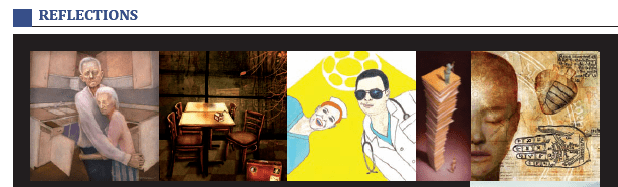
Here are the opening paragraphs of the short intro I wrote for our special December edition of the Reflections column. Since the illustrations are an important part of this column’s presentation, I’d suggest clicking through to the PDF versions of the articles linked to below:

“There is a dialectic at the heart of healing that brings the care giver into the uncertain, fearful world of pain and disability and that reciprocally introduces patient and family into the equally uncertain world of therapeutic actions.” —Arthur Kleinman, The Illness Narratives: Suffering, Healing, and the Human Condition

In recent years, the role of narrative in medicine and nursing has gained (or perhaps regained?) a certain amount of respect.

Some advocates value the stories of patients and practitioners because they bring us in from the cold, reminding us of the human side of an increasingly technology-driven field. Others argue for narrative as a crucial source of knowledge about disease processes and best practices, yet another form of evidence in the constant quest to improve outcomes. Others focus on the therapeutic aspect of such writing, our deep need to make sense of encounters shaped by loss, pain, and suffering, whether witnessed or experienced.

The Reflections column has been appearing monthly, with rare gaps, since 1983, when AJN debuted this and other new columns (as well as its editorial board). Reflections […]

Worsening Global Health Workforce Shortage: What’s Being Done?

JM: photo emailed to you. Photo is of Frances Day-Stirk, president of the International Confederation of Midwives, and David Benton, CEO of the International Council of Nurses. Photo courtesy of Marilyn DeLuca, consultant, Global Health - Health Systems  and adjunct associate professor, College of Nursing, New York University. Frances Day-Stirk, president, International Confederation of Midwives, and David Benton, CEO of International Council of Nurses. Photo courtesy of Marilyn DeLuca.

By Shawn Kennedy, MA, RN, AJN editor-in-chief

While it might seem—based on what we see in our own country—that there is no shortage of health care workers, there is indeed a global shortage and it’s only going to get worse. We reported on the global health workforce last year; new reports are revealing just how much worse things may get. According to the World Health Organization (WHO), by 2035 there will be a shortage of 12.9 million health care workers; currently, there is a shortage of 7.2 million.*

The shortage is being exacerbated by a confluence of occurrences:

When There’s a Disconnect Between Good Nursing Practice and Reality

Recently I spoke with other nurses about our personal experiences with hospitalization and those of family members, and the conversation turned to disappointment with nursing practice and nursing care. In fact, whenever I’ve asked, every colleague has disclosed a similar experience. Some say that they’d never leave a family member alone in a hospital.

We need to acknowledge that there is a disconnect between what we know to be good practice and what is often the reality—even in facilities with Magnet accreditation. There are far too many instances in which nursing practice is substandard.

shawnkennedyThis is a heads-up about Shawn Kennedy’s editorial in this month’s issue of AJN, excerpted above. You should read it. The article, “Straight Talk About Nursing,” is free. There are no easy answers to the issues it raises. That’s all the more reason to discuss them openly.

In AJN, we often focus on examples of best practices and insightful, compassionate, engaged care. And we get that there are many institutional obstacles that undermine nurses in their attempts to provide quality care to patients. But even so, we’d be remiss to pretend we don’t hear about, and sometimes personally experience, care that simply falls short. This is scary, at least to me. Patients depend on nurses in so many ways. So have a look at the article and let us know your thoughts, as a nurse or as a patient.—Jacob Molyneux, senior editor

Go to Top