

AJN’s September Issue: Anaphylaxis at School, Central Line Care, EBP, More
SeptemberAJN’s September issue is now available on our Web site. Here’s a selection of what not to miss.

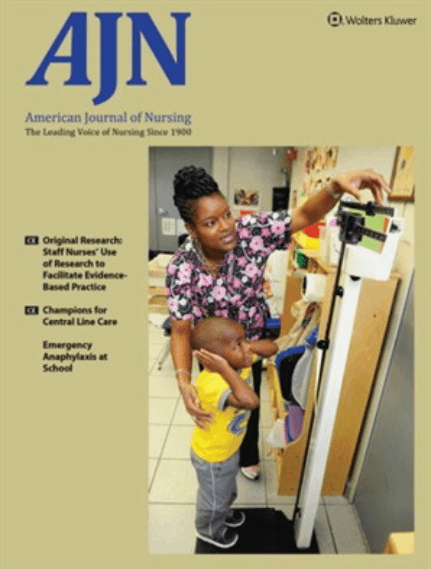
It’s back-to-school time, and on our cover this month is a photo of Head Start nursing supervisor Travia Williams weighing a student in the program’s classroom at Cocoa High School in Brevard County, Florida. The program provides enrolled children with screening, physicals, and other health care services.

According to the National Association of School Nurses, a third of all school districts in the United States have reduced nursing staff and a quarter don’t have any nurses at all. Yet there is the potential for more emergencies in school now than ever, with school nurses treating increasingly complex medical conditions and chronic illnesses. For more on the important role school nurses play in handling these health emergencies, see the In Our Community article, “Emergency Anaphylaxis at School.” And don’t miss a podcast interview with the author (this and other podcasts are accessible via the Behind the Article page on our Web site or, if you’re in our iPad app, by tapping the icon on the first page of the article).

Applying EBP to Practice. Despite the recognized importance of evidence-based practice (EBP), there continues to be a gap between the emergence of research findings and their application to practice. In this month’s original research article, “Staff Nurses’ Use […]

How a Busy Hospital Reduced Its Rate of Hospital-Acquired Pressure Ulcers to Zero

By Sylvia Foley, AJN senior editor

A skin lesion monitoring form accompanies a patient. Photo courtesy of NHCH. A skin lesion monitoring form accompanies a patient. Photo courtesy of NHCH.

In 2009, when one of the world’s largest cardiac care hospitals experienced a spike in the number of surgeries performed and a corresponding rise in hospital-acquired pressure ulcers, many people were concerned. The hospital—Narayana Hrudayalaya Cardiac Hospital (NHCH) in Bangalore, India—soon initiated a program to address the problem, and nursing superintendent Rohini Paul was tasked with designing and implementing effective preventive strategies. In this month’s CE feature, “Sustaining Pressure Ulcer Best Practices in a High-Volume Cardiac Care Environment,” Paul and colleagues describe what happened next. Here’s a brief overview.

Baseline data showed that, over the five-month observation period, an average of 6% of all adult and pediatric surgical patients experienced a pressure ulcer while recovering in the NHCH intensive therapy unit (ITU). Phase 1 implementation efforts, which began in January 2010, focused on four areas: raising awareness, increasing education, improving documentation and communication, and implementing various preventive practices. Phase 2 implementation efforts, which began the following month, focused on changing operating room practices. The primary outcome measure was the weekly percentage of ITU patients with pressure ulcers.
By July 2010, that percentage was reduced to zero; as of April 1, 2014, the hospital has maintained this result. Elements that contributed significantly to the program’s success and sustainability include strong leadership, nurse and physician involvement, an […]

2017-07-27T14:45:11-04:00August 8th, 2014|nursing perspective|7 Comments

AJN’s March Issue: New Series on Systematic Reviews, HIV Update, C. Diff on the Rise, Sexual Assault, More

AJN0314.Cover.OnlineAJN’s March issue is now available on our Web site. Here’s a selection of what not to miss, including two continuing education (CE) articles that you can access for free.

Advances in HIV testing and treatment. The photo on our cover, showing members of  Sexy With A Goal (SWAG), a program provided for lesbian, gay, bisexual, and transgender individuals affected by HIV and AIDS by the AIDS Service Center of New York City’s Lower East Side Peer Outreach Center, reflects the changing face of the AIDs epidemic. Thirty years ago, a diagnosis of HIV was tantamount to a death sentence. But the young men on our cover prove that this is no longer the case. With advances in treatment and patient advocacy, education, and support, HIV is now a chronic, manageable disease. A CE feature, “Nursing in the Fourth Decade of the HIV Epidemic,” discusses HIV epidemiology and policy in the United States, the HIV care cascade, advances in HIV testing and treatment, and how nurses can continue to have a positive impact on the HIV epidemic.

If you’re reading AJN on your iPad, you can watch a video describing one author’s early experience with an HIV-infected patient by tapping on the podcast icon on the first page. The video is also available on our Web site. A

New option for victims of sexual assault. Until recently, survivors of sexual assault were not […]

AJN’s Top 15 Most Viewed Articles in 2013

by rosmary/via Flickr by rosmary/via Flickr

We thought readers might be interested in seeing which articles and topics got the most page views in 2013. Many of these articles are open access, including a number of CE articles as well as the articles from our Evidence-Based Practice: Step by Step series. Some articles require an AJN subscription or individual article purchase. Several of the articles in this list were from recent years other than 2013; a couple were much older, but are evidently still relevant, since not every idea in nursing is ephemeral or subject to improvement by the next generation.—Jacob Molyneux, senior editor

1. “Asking the Clinical Question: A Key Step in Evidence-Based Practice” – (March, 2010) – part of AJN‘s EBP series

2. “Improving Communication Among Nurses, Patients, and Physicians” – (November, 2009)

3. “The Seven Steps of Evidence-Based Practice” – (January, 2010) – part of our EBP series

4. “Nurses and the Affordable Care Act” – (September, 2010)

5. “From Novice to Expert: Excellence and Power in Clinical Nursing Practice” – (December, 1984; not HTML version; readers must click through to PDF version)

6. “COPD Exacerbations” – (CE article; February, 2013)

7. “Therapeutic Hypothermia After Cardiac Arrest” – (CE; July, 2012)

8.

2016-11-21T13:05:35-05:00January 24th, 2014|Nursing|0 Comments

Tightly Scripted: One NP’s Experience with Retail Clinics

By Karen Roush, MS, RN, FNP-C, AJN clinical managing editor

Retail health clinics (walk-in clinics that are in a retail setting such as a drugstore or discount department store)KarenRoush have become an effective mode of providing increased access to care for many people and a growing source of employment for nurse practitioners (NPs). Their place in the health care arena may take on even more significance as the Affordable Care Act (ACA) increases access to care for previously uninsured people.

I worked as an NP in a retail clinic for about six months while working on my PhD. I left because of concerns I had about the model of practice. It didn’t have to do with the fact that I had to mop the floor at closing time or collect the fees and cash out the “drawer” every night. Nor because I spent eight hours alone in a small windowless room tucked away in the back of a drugstore. Those aspects were not great, but they weren’t deal breakers.

What was a deal breaker was the rigid programming of my practice. The computer was in control. From the moment the patient checked in at the kiosk outside my door, every action was determined by the computer.

The organization I worked for prided itself on following evidence-based […]

2016-11-21T13:06:09-05:00November 1st, 2013|career, nursing perspective|2 Comments
Go to Top