

Web Roundup: Comparing Online Health Info, Questioning a Breast Cancer Treatment, Guilt in Any Gender

Many women with early breast cancer do not appear to need removal of their lymph nodes, as is often recommended, according to a federally funded study released Tuesday.

Read the full Washington Post story about a new study published in JAMA (abstract is here). This story is being covered in most major news sources today, and it may signal a significant treatment shift for some patients. (One of the possible adverse long-term effects of lymph node removal is lymphedema. Here’s a page with links to the two-part article we ran about the condition a while back, as well as a related blog post by senior editor Sylvia Foley that looked at what people had been writing about their experiences with this condition.)

Speaking of advice about your health and about treatments, the health care journalism blog Covering Health alerts us today to an article at the NY Times comparing health information found at the WebMD and Mayo Clinic sites. Do you prefer the glitzy, highly produced one with lots of corporate sponsors, or the nonprofit? You know which one gets more visitors . . .

And speaking of patients, as we should, what about those who are transgendered? Does it confuse or challenge you to care for such a patient? There’s a very sensitive and painful post at the blog Nursetopia about caring for a transgendered patient […]

2016-11-21T13:14:03-05:00February 9th, 2011|Nursing|0 Comments

The Shape of a Woman: Two Poems in ‘Art of Nursing’

By Sylvia Foley, AJN senior editor

“I think about the woman / wilting // on the pillow of the steering wheel,” begins Stacy R. Nigliazzo’s poem “Sketch,” featured in this month’s Art of Nursing department. As the title suggests, the poem sketches out a scene, the immediate aftermath of a car accident. The driver appears dead; the paramedics “offer her up, prostrate / in white splints,” while the physician records the time. The narrator—who might be an ED nurse (perhaps Nigliazzo, an ED nurse herself)—describes what she sees. And as she does, we feel the terrible burden of her witnessing: the victim’s eyes brim “like black bowls that can’t be filled.” When the victim has been taken away, we’re left with almost nothing, only some coins and “buckled lines / in the shape of a woman.” It’s a short, spare piece that conjures up far more complicated matters, like where the dead reside, and how the living might go on.

The narrator of “Connection,” the poem by Camille Norvaisas that’s featured in January’s Art of Nursing, has undergone a double mastectomy. She is shockingly direct in her stated desire. “I want to feel the same / as my nipples, so cold, / in some jar in a sterile lab,” she tells us. She’s trying to comprehend a literal disconnection: once her breasts were part of her; now, “referred to as tissue,” they lie on a stainless […]

2016-11-21T13:14:06-05:00February 4th, 2011|nursing perspective|2 Comments

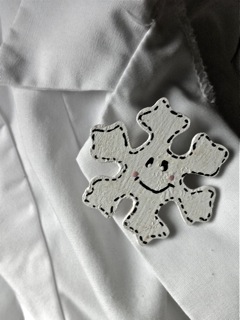
The Puzzle of Snowflakes: Treatments May Be Uniform, But Patients Are Not

Julianna Paradisi blogs at JParadisi RN; her artwork appeared on the cover of the October 2009 issue of AJN, and her essay, “The Wisdom of Nursery Rhymes,” is upcoming in the February issue.

My patient sits in a chair, watching a DVD presentation about caring for his new, surgically inserted, tunneled catheter. In a few weeks, this catheter will be used for his stem cell transplant. I am teaching him how to flush it and change the dressing. He’s from out in the sticks, too far away from the clinic for our nursing staff to provide the care for him. He doesn’t have family or friends for support. After the DVD, I bring out a chest manikin and dressing kit to demonstrate the sterile dressing change. As I explain the technique of donning sterile gloves, he stops me with a challenging glare.

“I can’t do sterile.”

I stop what I’m doing to explain the dangers of infection if the dressing isn’t sterile. Like a car stuck in a snowdrift, he remains unbudged. “I can’t do sterile,” he insists. I puzzle over what to say next. My coworkers flurry by in their white lab coats. I’m wearing a white lab coat, too. My patient is lost in a health care blizzard. He doesn’t see snowflakes. He only sees snow.

Taking A Stand Against Terminal Illness — Self-Delusion, or the ‘Good Fight’?

By Shawn Kennedy, MA, RN, AJN interim editor-in-chief

This week, The New York Times published an article about a young palliative care specialist who, when advised her cancer had progressed to the point where she should consider palliative care, rejected the notion and proceeded to pursue all available options. She was only 40 years old and said she was not ready to die. While the aggressive treatments (which she had plenty of money to pursue) gave her about another year, the article explains that her final days were spent heavily medicated for pain from the tumors throughout her body—even as she continued to request brutally painful procedures with little chance of prolonging her life.

That was her choice, and she knew what she was choosing. But that doesn’t always happen; too often, people really don’t know what it may cost them to take a stand against the inevitable. (For an engaging and comprehensive look at the issue and its implications for nurses, see Life Support Interventions at the End of Life: Unintended Consequences in the January issue of AJN.)

This month, AJN’s Reflections essay describes a scenario when full disclosure of the likely results of pursuing treatment wasn’t forthcoming from health providers. It tells of one nurse’s dilemma in balancing her role as family member and as a nurse during the last days of […]

‘What’s Not to Like?’ A British Nurse, Recently Treated for Cancer, Weighs In on U.S. Health Reform

Here’s a little perspective on health care reform in the U.S. from AJN’s contributing editor on international health. Jane Salvage, RGN, BA, MSc, HonLLD, FQNI, is a visiting professor at the Florence Nightingale School of Nursing and Midwifery, King’s College, London, and recently spent a year on the Prime Minister’s Commission on the Future of Nursing and Midwifery.

Just two weeks ago I learned I had a stage 1 endometrioid adenocarcinoma—a cancer in the lining of my womb. In many other countries today, and in the UK until recent years, this would eventually have killed me. But here I am today, happily home after a hysterectomy, probably cancer-free, thanking my lucky stars and our British National Heath Service (NHS).

My life has been saved by an army of people, from nurses and doctors to lab assistants, many of whom I’ll never meet. All my high quality care was free at the point of delivery, efficiently funded from my taxes instead of boosting the profits of insurance officials or millionaire surgeons. And I am pleased that my taxes have also subsidized the care of the demented, impoverished old lady in a nearby bed, even though her hollering and howling kept us awake most of the night.

What’s not to like? A great deal, you’d think from the nonsense talked about our UK NHS during your U.S. health reform debates. Last September, visiting the Robert Wood Johnson Foundation Initiative on the Future of Nursing, I stayed at the same […]

Go to Top