Those Who Wait: Recent Work in ‘Art of Nursing’

By Sylvia Foley, AJN senior editor

“I held that stone / in my hand for hours while they split your bones,” says the narrator of Janet Parkinson’s poem “Talisman,” which appears this month in Art of Nursing. The poem speaks to the tremendous strain of waiting for the outcome of a loved one’s emergency surgery. It’s about the  need for connection over great distances, for a “stone constant” in the face of grave uncertainty. The poet’s voice is unsentimental and steady, and the poem, just seven lines, itself feels almost talismanic. (Art of Nursing is always free online—just click through to the PDF file.)

In Roger Davies’s poem “Preparing to Pretend to Knit at the Chemotherapy Clinic,” featured in October’s Art of Nursing, a husband also waits, feeling helpless. “I’ll choose the long, elegant needles,” he says, imagining homespun wools dyed in autumn colors. Recalling his mother’s “nonchalant / competence” at the craft, he longs for the solace found in knowing what to do—even if it’s only how to hold the needles. In the poem’s last lines, the narrator says, “I could look out the window / to this fading autumn day.” But it’s clear that he’s not quite ready to see that view yet.

Rebecca Thomas’s painting “The Waiting Room: Norma,” featured in November, depicts the artist’s grandmother, who […]

2016-11-21T13:11:08-05:00December 19th, 2011|Nursing, patient engagement|1 Comment

Reading Between the Whiteboard Lines in the ICU

By Marcy Phipps, RN, a regular contributor to this blog. Her essay, “The Soul on the Head of a Pin,” was published in the May 2010 issue of AJN.

My hospital uses dry-erase whiteboards as a tool to communicate with patients and family members. Mounted to the walls in the patients’ rooms, the boards are prominent and concise.  Aside from a lot of basic information, notes get added to the board when diagnostic tests are completed, when complementary therapies have been implemented, and when housekeeping staff visit. The “meat” of the board, however, is the section that addresses plans and goals for the day. The plans and goals are updated and modified continuously by nursing staff. They’re specific to each patient, yet, despite their personalization, the goals for ICU patients tend to fall into distinct categories.

The first category includes goals which are often set by the patients themselves. They tend to require a certain amount of collaboration and active participation. These types of goals, which include things like “maximize incentive spirometer use,” “ambulate,” and “advance diet,” imply a relatively healthy state and tend to predict transfer orders.

The next type of goal is aimed at restoring health and stability. These goals don’t necessarily require patient participation and often focus on pathophysiologic processes. On the whiteboards of these rooms, the listed goals are likely to include things like “wean ventilator,” “control agitation,” “control fever,” or “increase level […]

Health Care Work and Hypochondria: When Knowledge Equals Fear

By Amy M. Collins, associate editor

This Thursday I will graduate. Not from college—sadly, that was many years ago. Rather, I will finish a health anxiety class, taken in desperation when untimely hypochondria struck. I admit it. I’ve always been a bit of a worrier when it comes to health and illness. Working as a health care writer/editor doesn’t always help. I just have too much information at my fingertips, and a brain that jumps to the extreme (a pain in the side can mean cancer, and so on).

Before getting a degree in writing and journalism, I studied human biology with the intention of going into some type of health care work. But reading about diseases made me start to self-diagnose with fervor, so I decided to switch majors. And this was before the advent of the Internet, where one can constantly consult “Dr. Google.”

Years ago, while working at a medical publishing company in Spain, things got worse. I was put on the cardiovascular beat, which only increased my health fears. Diagnosed with mitral valve prolapse as a child, and on medication for arrhythmia at the time, reading about this particular disease made my heart literally flutter. My boss, recognizing my discomfort, took me off the topic and asked me to instead write […]

2016-11-21T13:11:10-05:00December 14th, 2011|Nursing|4 Comments

Say It Ain’t So: Another ‘No’ on the Cookie Dough

By Karen Roush, MS, RN, FNP-C, AJN clinical managing editor

I admit it. For me, the best part of baking chocolate chip cookies is eating the raw dough. I know there’s a risk for a food-borne illness, but it’s hard to resist at least one mouthful—well, maybe two—of that combination of brown sugar, butter, and chocolate chips. Now, just in time for the holiday baking season, there’s even more evidence that taking that bite is not such a great idea.

A recent study by Neil and colleagues found that a 2009 outbreak of Escherichia coli was associated with eating raw cookie dough: 77 people across multiple states came down with an E. coli O157:H7 infection. The researchers found the common exposure was to a  ready-to-bake, prepackaged cookie dough that the patients had eaten raw. They believe the most likely culprit in the dough was contaminated flour. (The researchers note that flour has been implicated in food-borne Salmonella and E. coli outbreaks in the past.)

So, when educating patients about safety this holiday season, remind them that food products meant to be cooked or baked should never be eaten raw. As for me, this holiday I think I’ll head to the bakery and stay out of temptation’s way.

What other holiday safety tips have you got for patients?

Bookmark and Share

2016-11-21T13:11:11-05:00December 12th, 2011|Nursing|1 Comment

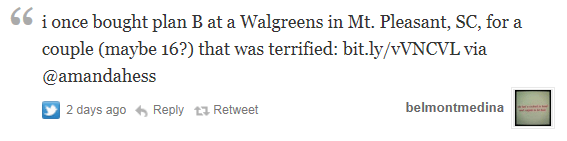
Perspectives on Sebelius Overrule of FDA on Plan B

Women’s health advocates were quick to cry foul Wednesday when Health and Human Services Secretary Kathleen Sebelius overruled the opinion of the Food and Drug Administration that the popular “morning after” emergency contraceptive “Plan B One Step” should be allowed to be sold without a prescription — and without age restrictions.

That’s from an NPR story on the response of women’s groups to the ruling by HHS head Sebelius. Many others have weighed in via various forums since the ruling. What gives? Is the decision politically motivated? Or was it because Sebelius actually believed in the rightness of her objection enough that she should overrule the FDA, something that’s apparently not at all usual practice?

Here are some quotes from an MSNBC Vitals blog article about the issue, from a major ethicist and from a leader in pediatric care:

“In facing a tough call, HHS has put politics over science when it comes to sex,” said Art Caplan, director of the Center for Bioethics at the University of Pennsylvania and a frequent contributor to msnbc.com.

Dr. Robert Block, president of the American Academy of Pediatrics, called the decision “medically inexplicable,” saying that it defies strong data that shows emergency contraception is safe and effective for girls and women of all ages.

President Obama has come […]

2016-11-21T13:11:12-05:00December 8th, 2011|Nursing|3 Comments
Go to Top