

Patient Decisions: When You’re Just Not Up to Making the Call

By Karen Roush, MS, RN, FNP, clinical managing editor

Photo by the author Photo by the author

For most patients and in most clinical situations, decision making is and should be a shared process between the patient and the clinician (and often the family). But there are some cases when we, expert clinicians versed in scientific and experiential knowledge, need to make a decision for the patient—not out of some paternalistic idea of our authority or superiority, but because the patient really wants or needs us to take on that burden.

I was six months pregnant with my second child. The pregnancy had gone smoothly, which was a blessing after having delivered my first child 10 weeks premature following two weeks spent in a tertiary care center. That pregnancy had been problematic from the beginning—early bleeding, and then a hemorrhage at five months, at which time they’d diagnosed me with placenta previa. It was one of those pregnancies where you were thankful for each additional day that brought you closer to the nine-month mark.

But this time, everything was going smoothly—no bleeding or cramps, an active baby that ultrasounds confirmed was growing well . . . until one morning in February, when I started with cramps that progressed to pain and a lot of pressure. An hour later, I was in the labor and […]
The ‘Dialectic at the Heart of Healing’

Capture
By Jacob Molyneux, senior editor

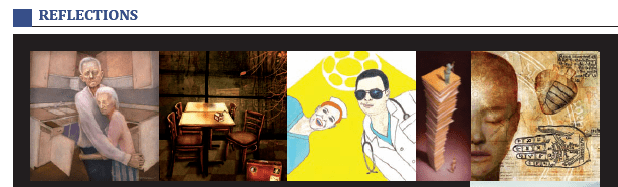
Here are the opening paragraphs of the short intro I wrote for our special December edition of the Reflections column. Since the illustrations are an important part of this column’s presentation, I’d suggest clicking through to the PDF versions of the articles linked to below:

“There is a dialectic at the heart of healing that brings the care giver into the uncertain, fearful world of pain and disability and that reciprocally introduces patient and family into the equally uncertain world of therapeutic actions.” —Arthur Kleinman, The Illness Narratives: Suffering, Healing, and the Human Condition

In recent years, the role of narrative in medicine and nursing has gained (or perhaps regained?) a certain amount of respect.

Some advocates value the stories of patients and practitioners because they bring us in from the cold, reminding us of the human side of an increasingly technology-driven field. Others argue for narrative as a crucial source of knowledge about disease processes and best practices, yet another form of evidence in the constant quest to improve outcomes. Others focus on the therapeutic aspect of such writing, our deep need to make sense of encounters shaped by loss, pain, and suffering, whether witnessed or experienced.

The Reflections column has been appearing monthly, with rare gaps, since 1983, when AJN debuted this and other new columns (as well as its editorial […]

When There’s a Disconnect Between Good Nursing Practice and Reality

Recently I spoke with other nurses about our personal experiences with hospitalization and those of family members, and the conversation turned to disappointment with nursing practice and nursing care. In fact, whenever I’ve asked, every colleague has disclosed a similar experience. Some say that they’d never leave a family member alone in a hospital.

We need to acknowledge that there is a disconnect between what we know to be good practice and what is often the reality—even in facilities with Magnet accreditation. There are far too many instances in which nursing practice is substandard.

shawnkennedyThis is a heads-up about Shawn Kennedy’s editorial in this month’s issue of AJN, excerpted above. You should read it. The article, “Straight Talk About Nursing,” is free. There are no easy answers to the issues it raises. That’s all the more reason to discuss them openly.

In AJN, we often focus on examples of best practices and insightful, compassionate, engaged care. And we get that there are many institutional obstacles that undermine nurses in their attempts to provide quality care to patients. But even so, we’d be remiss to pretend we don’t hear about, and sometimes personally experience, care that simply falls short. This is scary, at least to me. Patients depend on nurses in so many ways. So have a look at the article and let us know your thoughts, as a nurse or as a patient.—Jacob Molyneux, senior editor

Family Pet Visitation: A Nurse-Led Project at One Illinois Hospital

AJN1213.Cover.Online

We hear a lot about therapy dogs that are specially trained to visit patients in the hospital. But I for one would want to see not just any dog but my own dog, if I were gravely ill and in the hospital. I know I’m not alone, and some nurses set out to determine the pros and cons of making pet visits happen for some patients in their hospital. What safety concerns might there be? According to the current available research, what benefits might patients experience? What protocols would be necessary if it were to happen?

Nurses from Memorial Hospital in Belleville, Illinois, set out to answer these questions and bring such a program to life. They give the details in “Family Pet Visitation,” a feature article in the December issue of AJN (free for a month), along with some moving photos of patients and their pets. Here’s a quote from the start:

[…]

A Patient’s Take on Patient Satisfaction Surveys

PSS

By Amy M. Collins, editor

As an editor at AJN, I come across a lot of information on performance measures and Hospital Consumer Assessment of Healthcare Providers and Systems (HCAHPS) surveys. It’s a hot topic that we’ve covered several times, with some health care providers railing against these surveys and questioning whether satisfaction during a hospital stay is the same as quality care (see the September Editorial and the July 2012 Viewpoint for more on this).

Yet as usual, reading about a topic isn’t entirely the same as experiencing it. A few days after undergoing a small, non-emergency, in-office medical procedure, I was surprised to find a patient satisfaction survey in my e-mail inbox. Busy and flooded with many other e-mails, I was tempted to banish the survey to the trash can, especially since I didn’t feel I had much to say. But curiosity got the better of me.

The survey started off easily enough, as I clicked through questions such as “Was your waiting room time under 15 minutes?”; “Were the receptionists polite?”; “Was our facility clean?”

But as the survey crept forward, I began to feel overwhelmed by the sheer number of questions. Many questions seemed redundant; for example, I answered about five related to waiting times. Are they trying to catch patients out on inconsistent answers? All the while a green bar at the top […]

2016-11-21T13:06:17-05:00October 14th, 2013|patient engagement|1 Comment
Go to Top