AJN’s September Issue: Anaphylaxis at School, Central Line Care, EBP, More

SeptemberAJN’s September issue is now available on our Web site. Here’s a selection of what not to miss.

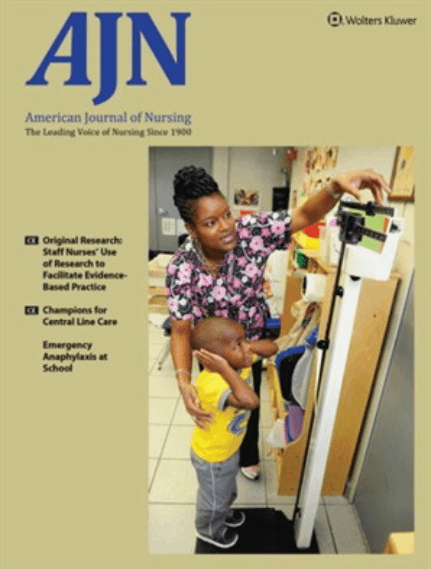
It’s back-to-school time, and on our cover this month is a photo of Head Start nursing supervisor Travia Williams weighing a student in the program’s classroom at Cocoa High School in Brevard County, Florida. The program provides enrolled children with screening, physicals, and other health care services.

According to the National Association of School Nurses, a third of all school districts in the United States have reduced nursing staff and a quarter don’t have any nurses at all. Yet there is the potential for more emergencies in school now than ever, with school nurses treating increasingly complex medical conditions and chronic illnesses. For more on the important role school nurses play in handling these health emergencies, see the In Our Community article, “Emergency Anaphylaxis at School.” And don’t miss a podcast interview with the author (this and other podcasts are accessible via the Behind the Article page on our Web site or, if you’re in our iPad app, by tapping the icon on the first page of the article).

Applying EBP to Practice. Despite the recognized importance of evidence-based practice (EBP), there continues to be a gap between the emergence of research findings and their application to practice. In this month’s original research article, “Staff Nurses’ Use […]

How Do You Define Nursing?

Virginia Henderson Virginia Henderson

By Maureen Shawn Kennedy, AJN editor-in-chief

Fifty years ago this month, in the August issue of AJN, Virginia A. Henderson, one of nursing’s giants, explained how she came to her definition of nursing: “The unique function of the nurse is to assist the individual, sick or well, in the performance of those activities contributing to health or its recovery (or to peaceful death) that he would perform unaided if he had the necessary strength, will or knowledge.” (We’ve made the article, “The Nature of Nursing,” free until September 30. Click through to the PDF under “Article Tools.”)

Many (older) nurses may remember Henderson as one of the authors of Harmer and Henderson’s The Principles and Practices of Nursing, a mainstay textbook for nursing schools, or for her internationally published book, Basic Principles of Nursing Care, which was translated widely. She also taught nursing at Teacher’s College, Columbia University, and then later at Yale University, where she developed a comprehensive index of nursing research. But her accomplishments went far beyond that. Her writings helped change how nursing was being regarded—from an occupation that existed only to provide physicians with helpmates to a scholarly, independent profession.

I had the good fortune to meet Henderson in the early 1990s, when she came to AJN’s offices to meet with Fred Pattison, AJN’s librarian at the time, who was also the editor of the International Nursing Index. She was warm, engaging, down-to-earth, and had […]

2016-11-21T13:04:01-05:00August 27th, 2014|career, Nursing|2 Comments

Coincidental Violence Against a Nurse: More Prepared Than You Think?

Julianna Paradisi, RN, OCN, writes a monthly post for this blog and works as an infusion nurse in outpatient oncology.

The Myth of Closure/ oil stick and charcoal on paper 2014/ Julianna Paradisi The Myth of Closure/ oil stick and charcoal on paper 2014/ Julianna Paradisi

Recently I was attacked by a stranger while running in the bright, mid-morning sunlight of summer through a populated urban setting.

My attacker did not know I am a nurse, so it’s only coincidental that it was violence against a nurse. However, I believe my nurse’s training contributed to choices I made in response.

How It Began: As I was running towards home through a busy recreational area along the river, a disheveled man on a bicycle turned a corner from the opposite direction and I swerved left to avoid collision. I thought nothing of it, and continued on.

First Contact: A few yards later, the same man rode closely up alongside of me so suddenly that I was startled when he angrily yelled something in gibberish. My nurse’s education and experience had schooled me not to react, not to make eye contact, and to get out of his personal space. At this point, the sidewalk forked. The stranger continued towards the left. I went right, on the greenway along […]

Essentials for New Clinical Nursing Instructors, Especially Adjuncts

There are many things it’s helpful to know when you start work as a clinical instructor—and you might not get a lot of orientation first.

By Maureen Shawn Kennedy, AJN editor-in-chief

“So you’ve accepted the contract for your first part-time clinical teaching assignment and you’re wondering where to start in preparing for this new role. Perhaps you’ve been working in an administrative role, away from direct caregiving. Maybe you’ve been active in bedside nursing but have no formal preparation in clinical teaching. If you take the time to prepare for your teaching assignment, you can confidently lead your students through a meaningful clinical experience.”

Revisiting Reality Shock – What’s Changed for New Nurses?

julie kertesz/ via flickr creative common julie kertesz/ via flickr creative common

By Maureen Shawn Kennedy, AJN editor-in-chief

Last month, we highlighted on Facebook a blog post I had written in 2010, “New Nurses Face Reality Shock in Hospital Settings – So What Else is New?” (It seemed timely in terms of all the June graduations.)

I wrote that original post in response to a study that had just been published in Nursing Outlook (here’s the abstract) describing the experiences of new nurses. Generally, these newbies felt harried, unprepared, overworked, and unsupported—all similar concerns voiced by nurses in Marlene Kramer’s 1974 book, Reality Shock: Why Nurses Leave Nursing. (Here’s AJN’s 1975 review of the book. It will be free for a month; note that you have to click the PDF link at the article landing page to read it.)

My post back in 2009 noted how nothing much seemed to have changed since the publication of Kramer’s book. Now, once again, this post has generated many comments, a number of them on our Facebook page as well as on the original blog post.

Here are a few. I’ll start with Facebook:

I’m almost a 20yr RN and have experienced [this] in a new job. I’ve developed skills to deal with this over the course of my career, so it doesn’t impact me like it […]

Go to Top