Nurses spend more time with patients than most other types of providers and have unique insight into patient care and the the healthcare system.

Whose Child Is This?

And I would do it again, but set down
This set down
This: were we led all that way for
Birth or Death? There was a Birth, certainly,
We had evidence and no doubt. I had seen birth and death . . .

—Excerpt from “The Journey of the Magi,” by T. S. Eliot

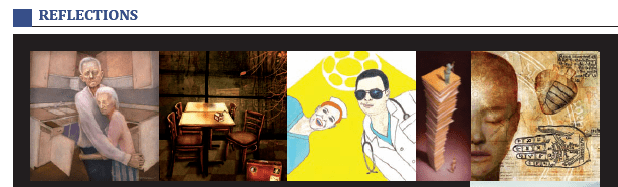
Painting: Untitled. Oil on Linen, 10" x 8" by Julianna Paradisi 2012-2013 Painting: Untitled. Oil on Linen, 10″ x 8″ by Julianna Paradisi 2012-2013

Julianna Paradisi, RN, OCN, writes a monthly post for this blog and works as an infusion nurse in outpatient oncology. The illustration of this post is by the author.

There is a nurse who loves running for exercise through a downtown park. And lo, it came to pass, one very cold day last year in December, that she came upon a host of people gathered around an unconscious man as he lay in the cold, wet grass.

Among them, three Wise Men were on their cell phones, calling 911.

These are my criteria for lending nursing skills to strangers:

▪    I witness the accident

▪   I’m the first one on the scene of an accident

▪    Others are first on the scene of the accident, but they don’t know what to do or are doing it wrong

This unfortunate man’s situation clearly fell […]

2016-11-21T13:05:52-05:00December 11th, 2013|career, nursing perspective|7 Comments

Worsening Global Health Workforce Shortage: What’s Being Done?

JM: photo emailed to you. Photo is of Frances Day-Stirk, president of the International Confederation of Midwives, and David Benton, CEO of the International Council of Nurses. Photo courtesy of Marilyn DeLuca, consultant, Global Health - Health Systems  and adjunct associate professor, College of Nursing, New York University. Frances Day-Stirk, president, International Confederation of Midwives, and David Benton, CEO of International Council of Nurses. Photo courtesy of Marilyn DeLuca.

By Shawn Kennedy, MA, RN, AJN editor-in-chief

While it might seem—based on what we see in our own country—that there is no shortage of health care workers, there is indeed a global shortage and it’s only going to get worse. We reported on the global health workforce last year; new reports are revealing just how much worse things may get. According to the World Health Organization (WHO), by 2035 there will be a shortage of 12.9 million health care workers; currently, there is a shortage of 7.2 million.*

The shortage is being exacerbated by a confluence of occurrences:

When There’s a Disconnect Between Good Nursing Practice and Reality

Recently I spoke with other nurses about our personal experiences with hospitalization and those of family members, and the conversation turned to disappointment with nursing practice and nursing care. In fact, whenever I’ve asked, every colleague has disclosed a similar experience. Some say that they’d never leave a family member alone in a hospital.

We need to acknowledge that there is a disconnect between what we know to be good practice and what is often the reality—even in facilities with Magnet accreditation. There are far too many instances in which nursing practice is substandard.

shawnkennedyThis is a heads-up about Shawn Kennedy’s editorial in this month’s issue of AJN, excerpted above. You should read it. The article, “Straight Talk About Nursing,” is free. There are no easy answers to the issues it raises. That’s all the more reason to discuss them openly.

In AJN, we often focus on examples of best practices and insightful, compassionate, engaged care. And we get that there are many institutional obstacles that undermine nurses in their attempts to provide quality care to patients. But even so, we’d be remiss to pretend we don’t hear about, and sometimes personally experience, care that simply falls short. This is scary, at least to me. Patients depend on nurses in so many ways. So have a look at the article and let us know your thoughts, as a nurse or as a patient.—Jacob Molyneux, senior editor

Family Pet Visitation: A Nurse-Led Project at One Illinois Hospital

AJN1213.Cover.Online

We hear a lot about therapy dogs that are specially trained to visit patients in the hospital. But I for one would want to see not just any dog but my own dog, if I were gravely ill and in the hospital. I know I’m not alone, and some nurses set out to determine the pros and cons of making pet visits happen for some patients in their hospital. What safety concerns might there be? According to the current available research, what benefits might patients experience? What protocols would be necessary if it were to happen?

Nurses from Memorial Hospital in Belleville, Illinois, set out to answer these questions and bring such a program to life. They give the details in “Family Pet Visitation,” a feature article in the December issue of AJN (free for a month), along with some moving photos of patients and their pets. Here’s a quote from the start:

[…]

Confronting Commercial Sexual Exploitation and Sex Trafficking of Minors in the U.S.: An IOM Report

[youtube=http://www.youtube.com/watch?v=CKh78vXIfis&w=640&h=360]
By Natalie McClain, PhD, RN, CPNP, clinical associate professor, William F. Connell School of Nursing, Boston College, and Barbara Guthrie, PhD, RN, FAAN, Independence Foundation Professor of Nursing, Yale University School of Nursing. The above educational video was created by the Institute of Medicine and is available on YouTube.

Each day in the United States, minors experience abuse and violence that is overlooked and unidentified. In some cases, recognition of the abuse makes these minors subject to arrest rather than assistance and care. These children and adolescents are the victims and survivors of commercial sexual exploitation and sex trafficking. A recent report from the Institute of Medicine (IOM) and the National Research Council sheds light on this serious domestic problem and underscores the critical role that nurses must play in preventing, identifying, and responding to these crimes.

Confronting Commercial Sexual Exploitation and Sex Trafficking of Minors in the United States is the culmination of a two-year study conducted by an independent panel of experts appointed by the National Academies of Science and funded by the Department of Justice’s Office of Juvenile Justice and Delinquency Prevention. The report states that commercial sexual exploitation and sex trafficking of minors are acts of abuse and violence against children and adolescents. However, the response to these victims is often starkly different from that experienced by other victims of child abuse and neglect. In most states, for example, underage victims of commercial sexual exploitation and sex trafficking can be arrested and prosecuted.

Long-term […]

Go to Top