

About Jacob Molyneux, senior editor/blog editor

Senior editor, American Journal of Nursing; editor of AJN Off the Charts.

Different Gods, Different Ideas of Compassion: A Clergywoman’s Story of the Doctor Who Wouldn’t
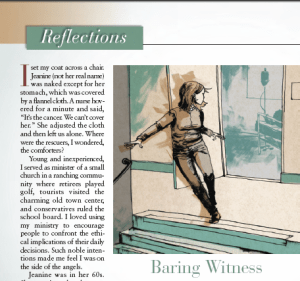
Jeanine was in her 60s. She wasn’t a church member and I barely knew her. A neighbor had called me to the hospital-Jeanine’s husband was dead, and there were no family or friends at her side. Trying to get my bearings, I leaned over her and recited the words of the Twenty-third Psalm: “The Lord is my shepherd …. Yea, though I walk through the valley of the shadow of death, I will fear no evil ….”

“Help me,” Jeanine moaned. Her eyes opened and then closed. I knew she was pleading for release from her pain.

“Jeanine, I’m so sorry,” I whispered. I hurried to the nurses’ station. When a young nurse looked up, I asked if she could do more to relieve Jeanine’s pain.

“Nothing more to do,” she said, looking back down at an open ledger.

The above is an excerpt from the Reflections essay in the December issue of AJN. It’s by a retired clergywoman who tells of a moment early in her career that brought her face to face with a doctor who believed in a very different kind of God than her own. Click the link above to read the essay in entirety.  

Bookmark and Share

2016-11-21T13:20:26-05:00December 23rd, 2009|Nursing|0 Comments

Helping Nurses Overcome Barriers to the Baccalaureate

By Shawn Kennedy, MA, RN, interim editor-in-chief

It’s not always easy for a nurse with an associate’s degree to obtain a baccalaureate. Many may have families to care for or support. Financial and time pressures can be considerable. The part-time community college model is great when it comes to obtaining the associate’s degree, but then many who want to advance find the door closed: they can’t afford the higher tuition at a local private school offering the baccalaureate, or they can’t travel from a rural community to an urban center where a city or state school is located, or they need to do a portion of their coursework on a part-time basis. With such barriers in place, how will we ever solve the nursing shortage?

These problems are being addressed. Last week I had the opportunity to speak with several faculty from the program in nursing at Queensborough Community College (QCC), City University of New York, including Tina Iakovou and Marge Riley, both assistant professors; Anne Marie Menendez, chair of the program; and Lucy O’Leary, a “student success advocate.” The meeting took place at the Hunter-Bellevue School of Nursing in New York City. Also present were Christine Tanner, a distinguished professor at Oregon Health and Sciences University (OHSU), and Marilyn DeLuca, formerly of the  Jonas Center for Nursing Excellence.

We were there to discuss the unique collaboration QCC has with Hunter-Bellevue, one based on a model developed by Tanner and colleagues in Oregon. Tanner […]

2016-11-21T13:20:31-05:00December 21st, 2009|Nursing|0 Comments

Poor Assessment of Nursing Home Residents’ Pain — What Can Be Done?

A recent study sought to find out whether relatives and caregivers (proxies) understood residents’ pain well enough to assist in pain assessment and to discover what factors affected their judgments of pain. The findings showed, however, that their reports didn’t consistently match the pain ratings of nursing home residents themselves.

It’s particularly difficult to assess pain in cognitively impaired nursing home residents. This means that there’s a lot of suffering that goes untreated. This AJN article in the December issue discusses the findings of a new study on the topic and offers some recommendations we obtained from the study authors. Here’s another excerpt:

The authors suggest that pain management in nursing homes could be improved through caregiver education, including the implementation of pain assessment education in combination with treatment. They recommend basic training for nurses and nursing assistants on pain, pain behavior, and pharmacologic and nonpharmacologic pain treatment, such as “massage, applying warmth, mobility[, and] distractions with music or story telling.” They also suggest that “treatment effects could be determined more easily using a pain observation scale.”

So check out the article, and also let us know what else can we do to more accurately assess the pain of nursing home residents.

Bookmark and Share

Nursing Yet Again the Most Trusted Profession. So What?

By Shawn Kennedy, MA, RN, interim editor-in-chief

I was catching up on my reading over the weekend and came across a press release issued December 9 by the ANA (American Nurses Association). It noted that “[f]or the eighth consecutive year, nurses have been voted the most trusted profession in America according to Gallup’s annual survey of professions for their honesty and ethical standards. Eighty-three percent of Americans believe nurses’ honesty and ethical standards are either ‘high’ or ‘very high.'”

Laudable for sure, but I keep wondering: does this matter to anyone but us? In the past eight years, has this designation helped nurses get to the policy table? Has it made key decision-makers realize that in addition to being trustworthy, nurses are also smart, skilled professionals who can be the key to cost-effective, quality care?

It’s really amazing (in an appalling sort of way): the groups among those with the lowest trust ratings—politicians and lawyers—dominate when it comes to making key decisions about health care (and about everything, actually). And we wonder why things are the way they are?

Bookmark and Share

And You Thought PE Was Another Name for Gym Class

By Jacob Molyneux, senior editor

The template goes something like this: Start with a legitimate quality-of-life issue — like fitful sleep or shyness — that does not yet have its own prescription medication and is debilitating to a few people a lot of the time. Next, position the quality-of-life issue as a medical condition with symptoms so common it covers vast numbers of people who had previously not identified themselves as having a health problem, or who thought they were just experiencing an occasional and normal annoyance.

According to the rest of this article in the NY Times, the latest disorder about to enter our dictionary of accepted medical conditions is premature ejaculation (PE). Several companies are developing treatments in the form of pills or aerosol sprays. The net of nonspecific symptoms seems to have been cast fairly wide—a representative of one drug company is quoted as saying that one in three men have this condition. 

Celebrities may soon be confessing that the anxiety occasioned by PE has led to ruined marriages, depression, drug use, and even the use of prostitutes. The ironies of the media campaign to push the term PE into our medical lexicon are worth considering as our legislators debate health care reform provisions and the crisis of rising costs. Medical bankruptcy is on the rise. Many cannot afford medications they need for serious conditions like heart disease and diabetes.

It may be premature to suggest it, but it seems likely the pharmaceutical companies expect health care reform legislation […]

Go to Top