Their Story: Each Patient is Someone’s Family Member

By Amy S. Jacobs, BSN, RN, CCRN. The author works as a critical care nurse in Tampa, Florida.

hospital corridorWhy does it usually take a personal experience of having a family member become a patient to make us see our patients in a new light—to see them as someone’s grandmother, father, sister, or spouse and not just a room number?

I’ve been a nurse in critical care for the past 10 years. Three of those years were spent as a travel nurse working short-term contracts in intensive care units across the country. And most of my ICU experience has been in trauma units.

I’ve watched a family come to grips with the fact their son is now brain-dead after a car accident.

I’ve comforted the husband and children of a patient who suddenly developed an infection and died after an apparently successful two-year treatment for cancer.

I’ve witnessed a daughter realize her dad is never going to be the same after a stroke takes away his mobility and speech.

I’ve seen a patient realize that, while he’s lucky to be alive after his motorcycle accident, he’s going to have to learn to navigate a new world without one of his legs.

As nurses we see these situations. We have sympathy for our patients and their families. We try to keep in mind the emotional support our patients need while also taking care of their physical […]

2016-11-21T13:00:57-05:00September 20th, 2016|Nursing, patient experience|3 Comments

A Measure of Contentment: One Patient’s Daily Ritual

By Annelisa Ochoa for AJN By Annelisa Ochoa for AJN

A Measure of Contentment,” the August Reflections essay in AJN, describes the daily ritual of a resident in a long-term care facility. As author Nancy Ngaruiya shows us, nurses and other health care providers can sometimes notice, and support, the small pleasures and routines that make life worthwhile for patients.

Of this patient, she writes:

We make our own happiness. We define what makes us content, what actions help us find that happiness. Sometimes the recipe takes just a few ingredients. Even in an environment where freedom is limited, where rules dictate when to wake up and go to bed, what days of the week we will get assistance with a full bath and who will do it, what meals and activities are or are not available, he has defined what makes him content, perhaps even happy.

The patient in question happens to be one of those who often get frustrated, who aren’t always grateful or helpful—those who tend to be labeled as “challenging” or “difficult” by overworked providers. It’s easy to notice only the frustration of people who’ve watched their worlds shrink bit by bit as their freedoms and abilities diminish along with their health.

Just Breathe: A Nurse’s Tough Love Proves Crucial During One Mother’s Labor

Photo by chintermeyer, via Flickr. Photo by chintermeyer, via Flickr.

By Amy Collins, AJN managing editor

The pain jolted me from my sleep. It was 1:30 in the morning. The sensation was stronger than anything I’d ever felt, and I grabbed my phone to start my contraction timer. I had read loads on labor and childbirth, and everything suggested I was in for the long haul. But my timer was showing the contractions were already only five minutes apart. I spoke with the hospital’s on-call physician, who told me to relax and spend as much time as possible at home so I could be more comfortable.

But within minutes, the pain had increased to a level where it was difficult to talk. The contractions were now three minutes apart and my water had broken. My husband and I decided to go to the hospital.

I’d like to say I was strong and handled the pain of labor well, but I was quickly losing control and succumbing to anxiety. By the time we got to the maternity unit, I was sobbing. The labor nurse assigned to me introduced herself as Jean. She was older and seemed seasoned, with a stern, no-nonsense attitude. She brought me to a delivery room and gave me a gown. Before labor started, my plan had been to see how […]

The Hospital as Foreign Country

Capture“A Foreign Place,” the February Reflections essay by Barbara Sosman, delves into one patient’s experience of the sometimes inscrutable, sometimes terrifying, sometimes humorous events and encounters in one small corner of a hospital.

Below are the first two paragraphs, but as always, it’s worth clicking through and reading the entire essay (the PDF version is best). This one would be particularly hard to summarize; it takes us to unexpected places.—Jacob Molyneux, senior editor

The flow of life and death in a hospital is mysterious, like the sound of a foreign language, and the mysteries that bring us here are profound. Stretched out in an unfamiliar hospital bed, I suppress realities, aware that tomorrow a scalpel will remove an enlarged node for a biopsy. The biopsy will show what I sense, a cellular chaos that threatens my life. Soon my disease will be presented like an offering. What will I do with it?

A room can become a universe and time there an infinity. This room is inhabited by women, of whom I am the youngest by decades  . . .

As always, comments are welcome.

Bookmark and Share

The ‘Dialectic at the Heart of Healing’

Capture
By Jacob Molyneux, senior editor

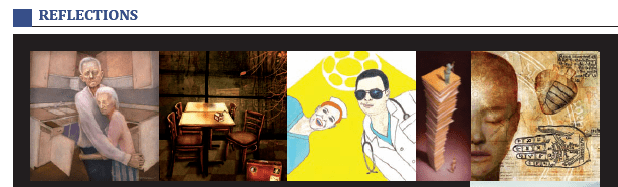
Here are the opening paragraphs of the short intro I wrote for our special December edition of the Reflections column. Since the illustrations are an important part of this column’s presentation, I’d suggest clicking through to the PDF versions of the articles linked to below:

“There is a dialectic at the heart of healing that brings the care giver into the uncertain, fearful world of pain and disability and that reciprocally introduces patient and family into the equally uncertain world of therapeutic actions.” —Arthur Kleinman, The Illness Narratives: Suffering, Healing, and the Human Condition

In recent years, the role of narrative in medicine and nursing has gained (or perhaps regained?) a certain amount of respect.

Some advocates value the stories of patients and practitioners because they bring us in from the cold, reminding us of the human side of an increasingly technology-driven field. Others argue for narrative as a crucial source of knowledge about disease processes and best practices, yet another form of evidence in the constant quest to improve outcomes. Others focus on the therapeutic aspect of such writing, our deep need to make sense of encounters shaped by loss, pain, and suffering, whether witnessed or experienced.

The Reflections column has been appearing monthly, with rare gaps, since 1983, when AJN debuted this and other new columns (as well as its editorial board). Reflections […]

Go to Top