

Always a Nurse

By Janice M. Scully. The author worked in psychiatric nursing for four years before becoming a physician. After 20 years as a physician, she retired to pursue a career as a writer. For more information, click here.
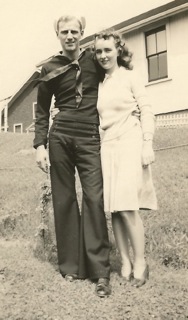
The author's parents The author’s parents

Nurses have to be resilient and resourceful—Florence Nightingale,  of course, is the template. My mother, Betty, was a smart and practical woman, the oldest of three siblings. She attended nurses’ training in the 1940s while the Second World War raged overseas. I have a photo of her as a young woman just out of high school, dressed in her starched uniform, standing by Binghampton (NY) City Hospital, her alma mater.

According to her, the lives of young nurses back then were not unlike the lives of nuns. After lights out in the dorm, the dorm mother would walk through and shine a light on each bed, as a night nurse on a medical ward at 2 AM might do. But instead of observing for signs of life, dorm mothers were checking to be sure the young female nurses were in their beds. Sometimes they weren’t.

Although the students might not be allowed out at night, they had a great deal of responsibility during the day. Nurses did everything for the sick, even the hospital laundry. They gave bed baths and back […]

2016-11-21T13:03:31-05:00November 19th, 2014|career, Nursing, nursing perspective|4 Comments

Ebola Changes You: Reflections of a Nurse Upon Return from Liberia

By Deborah Wilson, RN. The author is currently an IV infusion therapist with the Berkshire Visiting Nurses Association in Pittsfield, Massachusetts, and is completing her BSN at UMass Amherst. In October, she returned from Liberia, where she worked with Doctors Without Borders at a 120-bed Ebola treatment center. Names of patients mentioned in the article have been changed to protect patient privacy.

At the cemetery, newly dug graves At the cemetery, newly dug graves

I have recently returned from Liberia, where I worked as a nurse for six weeks along with a dedicated team of physicians, nurses, and other professionals, treating 60 to 80 Ebola patients a day. My 21-day transition time is recently over and, although I am back at work and school, my heart is with the West African nurses who I worked with for those weeks in September and October.

I worked in a town called Foya, managing a 120-bed Ebola treatment center (ETC). During the first two weeks, I wondered if I would last. In the grueling heat, dressed up in all that personal protective equipment (PPE), constantly sprayed with chlorine, each day I was haunted by the question of whether I’d somehow gotten infected.

It all took its toll. Twice a shift the nursing team would put on PPE and enter […]

Presence, Improvisation, Dark Humor: Crucial Skills of a Hospice Nurse

Illustration by Pat Kinsella for AJN. Illustration by Pat Kinsella for AJN.

Here’s the start of “Molly,” the Reflections essay in the November issue of AJN, written by hospice nurse Thom Schwarz.

Late evening, early spring, the peepers not yet trilling. I am in my car, rain streaking the windshield, reading a New Yorker essay about war writing, an ironic distraction from my visiting hospice nursing work.

This is a piece that doesn’t offer any easy answers for the facts of suffering and death. But it does posit a certain consolation in staying present, undaunted, engaged, and resourceful when faced with the power and mystery of each patient’s encounter with impending death.

All Reflections essays are free, so give it a look.—Jacob Molyneux, senior editor 

If She Yells ‘Help Me’ – Poster Therapy to Convey the Needs, Identity of an Ailing Parent

Joan Melton, MSN, lives in Indiana.

Photo by Ann Gordon, via Flickr Photo by Ann Gordon, via Flickr

I am a geriatric nurse practitioner and have also been the daughter to an ill, aging parent. I felt well trained for my professional role but struggled with the latter.

I joked that, despite my logical understanding of what was going on with my mother, it could be hard to accept her physical and functional changes, which sometimes seemed to fly in the face of logic. There were days Mom’s hospice nurses spent more time with me than with my mother. They’d sit and allow me to vent my frustration at watching my mother slowly leave me, at feeling overwhelmed and “losing my cool” with her, at not being able to practice the advice I’d so readily handed out to so many other families over the years, not being able to “fix it” and successfully comfort all of Mom’s fears and ailments 24 hours a day, seven days a week.

Yes, I know how unrealistic that last statement sounds. Thank goodness for hospice nurses, who reminded me that I was “the daughter” and did not need to be “the nurse practitioner.” They reminded me that as the daughter I had amazing insight no one else […]

2016-11-21T13:04:15-05:00July 23rd, 2014|Nursing, Patients|7 Comments

Codeine Overused in Children: Alternatives Exist for Hard-to-Manage Pain

By Jacob Molyneux, senior editor

According to a story at MedlinePlus, a study in Pediatrics has found that codeine is still prescribed too often to children during ER visits, though it’s known that a small but significant subset of children metabolize the painkiller far more rapidly than do other children, leading to potentially dangerous results. As AJN‘s February CE article on treating the often severe and stubborn posttonsillectomy pain in children noted, there are other effective and safer options for children in pain, such as hydrocodone in combination with acetaminophen, as well as some non-opioid analgesics. Here’s a brief overview of the article:

Tonsillectomy, used to treat a variety of pediatric disorders, including obstructive sleep apnea, peritonsillar cellulitis or abscesses, and very frequent throat infection, is known to produce nausea, vomiting, and prolonged, moderate-to-severe pain. The authors review the causes of posttonsillectomy pain, current findings on the efficacy of various pharmacologic and nonpharmacologic interventions in pain management, recommendations for patient and family teaching regarding pain management, and best practices for improving medication adherence.

There’s often no perfect answer in pain management, but it helps to know the full range of available strategies, their safety, and how well they work. As with all CE articles, this one is free.

Bookmark and Share

Go to Top