

Scrubs on the Street: Big Concern?

This colorized 2005 scanning electron micrograph (SEM) depicted numerous clumps of methicillin-resistant Staphylococcus aureus bacteria, commonly referred to by the acronym, MRSA; Magnified 2390x. CDC/via Wikimedia Commons This colorized 2005 scanning electron micrograph (SEM) depicted numerous clumps of methicillin-resistant Staphylococcus aureus bacteria, commonly referred to by the acronym, MRSA; Magnified 2390x. CDC/via Wikimedia Commons

By Shawn Kennedy, AJN editor-in-chief

Last week I came across this article on the Reporting on Health blog from the Annenberg School of Communications and Journalism at the University of Southern California. It discusses one woman’s campaign to get hospital health care providers to stop wearing scrubs outside of the hospital. She wants people to photograph the ‘offenders’ and send the photos to hospital administrators. She’s concerned that the clothing will pick up infection-causing bacteria in the community and spread infection to weak, immunocompromised patients.

Wearing uniforms outside of the clinical setting has been debated on and off for years. Here’s an excerpt from an editorial comment that appeared in the March 1906 issue of AJN (you can read the full article for free as a subscriber):

AJNArchiveExcerptNursesonStreet

‘Spread the Word, Not the Germs’ – Infection Control During Religious Gatherings

By Shawn Kennedy, MA, RN, AJN editor-in-chief

Last week there was a disconcerting report from the Associated Press about a Catholic clergyman in North Dakota who may have inadvertently exposed many members of his church to hepatitis A. According to the report, the ill bishop had probably contracted the illness from contaminated food while attending a conference in Italy and, because he didn’t immediately feel ill (incubation period usually ranges from two to four weeks, though can be as long as eight weeks), continued to dispense communion at several area churches.

According to the Centers for Disease Control and Prevention (CDC) Web page for hepatitis A, infection “is primarily transmitted by the fecal–oral route, by either person-to-person contact or consumption of contaminated food or water.” A person is infectious from two weeks before to one week after the onset of symptoms. The FAQ page on the site does say, in regards to infected food handlers (which would seem to fit this case, in that the bishop handled communion hosts), that “transmission to patrons is unlikely”—and also offers some guidance for postexposure prophylaxis (PEP). In this case, too much time had elapsed: PEP needs to be given within two weeks of exposure.

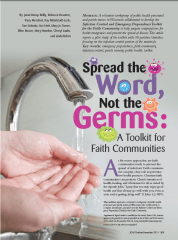
SpreadTheWordNottheGermsOpeningSpreadScreenshotThis situation made me wonder, though, as we’re about to enter peak flu season, if there are any infection control guidelines appropriate for religious services. Some […]

Tragedy into Policy: A Hepatitis C Outbreak and a Study of Nevada RNs Lead to New Protections for Whistleblowers

By Sylvia Foley, AJN senior editor

In 2008, more than 62,000 people who had undergone procedures at one of two southern Nevada endoscopy clinics were notified that “they might have been exposed to bloodborne pathogens, including hepatitis B virus, hepatitis C virus (HCV), and HIV, as a result of unsafe injection practices.” As author Lisa Black reports in this month’s CE–Original Research feature, a subsequent investigation by federal and state agencies found multiple breaches of infection control protocols. Indeed, 115 patients were found to be “either certainly or presumptively infected” with HCV through the reuse of contaminated medication vials.

Especially distressing was strong anecdotal evidence that because of a general fear of workplace retaliation, staff at the two clinics had often failed to report unsafe patient care conditions. At the request of the Nevada legislature, a study was conducted to examine Nevada RNs’ experiences with workplace attitudes toward patient advocacy activities. Black was the principal investigator. […]

Alone, Isolated, At Risk


By Shawn Kennedy, AJN editor-in-chief

I saw the following headline this week: “LA woman dies in her cubicle at work; body is not discovered until the following day.” The article said it was unclear how she had died. I hope it was at the end of the day after everyone had left; I really hope they don’t find out that she died midday, amidst coworkers who were going about their business. Maybe they were so busy that they never noticed the silence from her cubicle.

This story reminded me of two articles I read recently. One was an article that will be published in the Emerging Infections department in our March issue, which goes live at the end of next week on ajnonline.com. “The Contact Precautions Controversy” examines the issues around placing patients on contact precautions and in isolation—an approach that many hospitals use almost routinely for some patients. (We covered this issue in a news piece last July as well.) Recent studies are raising questions about this practice and the risks to these patients, who often have fewer interactions, get less care, and may feel neglected because health care providers limit contact.

The other article is one that’s in the headlines now.  The Boston Globe ran a story about […]

AJN’s Top 10 Articles in 2009

So, what were the most highly viewed articles of 2009 on AJNonline?

Here’s our Top Ten list – check them out:

1. Sex and Violence in the Media Influence Teen Behavior – duh!

2. Recognizing Sepsis in the Adult Patient – every nurse should know what to look for

3. Bullying Among Nurses – sad reminder that we might be our own worst enemy

4. Leech Therapy – it may be disconcerting, but it works wonders

5. The Marketing of Osteoporosis – how they turned a risk factor into a disease

6. The Nursing Shortage – this problem’s not going away soon

7. Understanding and Managing Burn Pain: Part 1 – it’s still misunderstood . . . and undertreated

8. Infection Control: Whose Job Is It? – unsafe nursing practices, you say?

9. Staging Pressure Ulcers: What’s the Buzz in Wound Care? – definitions matter!

10. Do Rapid Response Teams Save Lives? – well, it sounded like a neat idea . . .

–Shawn Kennedy, AJN interim editor-in-chief
Bookmark and Share

Go to Top