Presence, Improvisation, Dark Humor: Crucial Skills of a Hospice Nurse

Illustration by Pat Kinsella for AJN. Illustration by Pat Kinsella for AJN.

Here’s the start of “Molly,” the Reflections essay in the November issue of AJN, written by hospice nurse Thom Schwarz.

Late evening, early spring, the peepers not yet trilling. I am in my car, rain streaking the windshield, reading a New Yorker essay about war writing, an ironic distraction from my visiting hospice nursing work.

This is a piece that doesn’t offer any easy answers for the facts of suffering and death. But it does posit a certain consolation in staying present, undaunted, engaged, and resourceful when faced with the power and mystery of each patient’s encounter with impending death.

All Reflections essays are free, so give it a look.—Jacob Molyneux, senior editor 

On the Phone: Punctuation for a Parent’s Decline

Illustration by Elizabeth Sayles for AJN. All rights reserved. Illustration by Elizabeth Sayles for AJN. All rights reserved.

“It’s ridiculous. I’m deciding the rest of my mother’s life based on research I did on the Internet,” I tell him.

“You’re really good at that. Research, I mean,” he says, hope in his voice.

I want to scream that I don’t think an undergraduate degree in biology and a long relationship with Google qualify me as a medical professional.

Many of us don’t use the phone as often as we used to, but there are times of strangeness and loss when it may still assume the central role it played in an earlier era. The passage above is from “On the Phone,” the August Reflections essay, which finds a novel way to talk about the strains and strangeness of finding oneself a family caregiver—the gradual withdrawal of a once vibrant parent (or spouse or sibling) from the home that had once seemed to be defined by their presence, the isolation, the learning curve when faced with medical emergencies and the need to make crucial decisions that can’t wait, the reliance on the advice and interventions of nurses and physicians.

All Reflections essays are free and can be read in just a few minutes. This month’s is about an experience, family caregiving, that more and more of us are having in one form or another, whether we find a way to tell about it […]

When the Preceptor’s Attitude Is a New Nurse’s Biggest Challenge

FirstPreceptorIllustrationHere’s the start of “My First Preceptor,” the Reflections essay in the March issue of AJN.

“Manage your day,” she told me, not for the first time, as if it had been my fault that one patient crashed yesterday just as my second one returned from surgery with a new set of orders. I could not be in two places at once, keeping track of two critical patients, making sure each one received the care she needed at the moment she needed it.

A new critical care nurse has a lot to worry about. It’s easy to feel overwhelmed, even when you’re actually doing a pretty good job. A preceptor can play a crucial role in helping a new nurse find her or his footing. As one might expect, however, some good nurses are not good preceptors. In this essay, the author describes her struggles to deal with the time pressures of her new job, along with her preceptor’s constant admonitions and disapproval.

This fraught nurse–preceptor relationship reaches a crisis point against a backdrop of life and death struggles. I won’t try to summarize what happens in the essay, since different readers may interpret it differently, depending on experience and temperament. But it’s definitely worth a read.—Jacob Molyneux, senior editor

Bookmark and Share

The ‘Dialectic at the Heart of Healing’

Capture
By Jacob Molyneux, senior editor

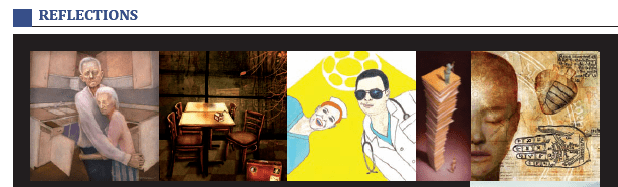
Here are the opening paragraphs of the short intro I wrote for our special December edition of the Reflections column. Since the illustrations are an important part of this column’s presentation, I’d suggest clicking through to the PDF versions of the articles linked to below:

“There is a dialectic at the heart of healing that brings the care giver into the uncertain, fearful world of pain and disability and that reciprocally introduces patient and family into the equally uncertain world of therapeutic actions.” —Arthur Kleinman, The Illness Narratives: Suffering, Healing, and the Human Condition

In recent years, the role of narrative in medicine and nursing has gained (or perhaps regained?) a certain amount of respect.

Some advocates value the stories of patients and practitioners because they bring us in from the cold, reminding us of the human side of an increasingly technology-driven field. Others argue for narrative as a crucial source of knowledge about disease processes and best practices, yet another form of evidence in the constant quest to improve outcomes. Others focus on the therapeutic aspect of such writing, our deep need to make sense of encounters shaped by loss, pain, and suffering, whether witnessed or experienced.

The Reflections column has been appearing monthly, with rare gaps, since 1983, when AJN debuted this and other new columns (as well as its editorial board). Reflections […]

We Call You ‘Wheat Head’ – An Unexpected Crosscultural Encounter

I entered the wall-less, thatch-roofed waiting area of the clinic with my right hand in a ball of bandages, taped to my chest. The airy space was almost empty, without nurses or even a receptionist. The only other person in the little space, sitting very elegantly on one of the narrow wooden benches, was a woman in traditional West African dress who was quite pregnant.

NovemberReflectionsThe November Reflections essay in AJN is called “Surprise!” Its opening paragraph is above. This is one of our occasional Reflections essays by a writer who is not a nurse. In this case, the author Thomas Turman’s easy, self-deprecating tone, and the matter-of-fact manner in which his unexpected patient faces a situation that might induce a certain panic in many people from wealthier countries, feels just right. […]

Go to Top