

Some Observations In Response to the NY Times Article on Palliative Sedation

By Judy Schwarz, PhD, RN*  


The NY Times article of 12/26/09 that described use of palliative sedation in hospice institutional settings provided helpful and clinically accurate informative—for the most part. These few notes are meant to address those issues raised by the article that may unduly alarm dying patients, their families, and their clinical caregivers.


1) 
There is a consensus among palliative care clinicians that “palliative sedation to unconsciousness” (a descriptive term that eliminates some of the visceral reaction elicited by use of the term “terminal sedation”) is an intervention used only when other therapies that do not compromise patient consciousness have failed and the patient continues to experience intolerable and intractable suffering that cannot otherwise be relieved.

2) Use of palliative sedation to unconsciousness has NOT been shown to cause a hastened death. Research showing that patients at the very end of life who receive palliative sedation do not die more quickly than patients who are not sedated has been published in such peer-reviewed journals as Annals of Oncology, Journal of Palliative Medicine, Journal of Pain and Symptom Management, Archives of Internal Medicine, and Palliative Medicine. (In response to the Times article, the National Hospice and Palliative Care Organization has made available a bibliography of these articles.)

This intervention is generally only provided when patients are “imminently” dying (a condition the recognition of which requires experience and clinical judgment) and is distinct from “respite sedation,” which is used when clinicians plan to awaken a patient from the unconscious state to […]
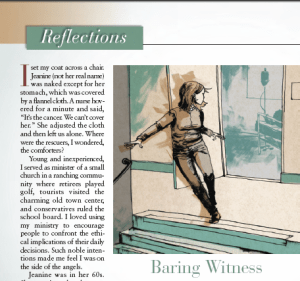
Different Gods, Different Ideas of Compassion: A Clergywoman’s Story of the Doctor Who Wouldn’t

Jeanine was in her 60s. She wasn’t a church member and I barely knew her. A neighbor had called me to the hospital-Jeanine’s husband was dead, and there were no family or friends at her side. Trying to get my bearings, I leaned over her and recited the words of the Twenty-third Psalm: “The Lord is my shepherd …. Yea, though I walk through the valley of the shadow of death, I will fear no evil ….”

“Help me,” Jeanine moaned. Her eyes opened and then closed. I knew she was pleading for release from her pain.

“Jeanine, I’m so sorry,” I whispered. I hurried to the nurses’ station. When a young nurse looked up, I asked if she could do more to relieve Jeanine’s pain.

“Nothing more to do,” she said, looking back down at an open ledger.

The above is an excerpt from the Reflections essay in the December issue of AJN. It’s by a retired clergywoman who tells of a moment early in her career that brought her face to face with a doctor who believed in a very different kind of God than her own. Click the link above to read the essay in entirety.  

Bookmark and Share

2016-11-21T13:20:26-05:00December 23rd, 2009|Nursing|0 Comments

The ER Exit vs. the Long Goodbye: Notes of a Hospice Nurse on the Morning After

“Mourning Dove Bailing,” Bob MacInnes/ via Flickr. “Mourning Dove Bailing,” Bob MacInnes/ via Flickr.

I’m exhausted and shaky, and the “pssssht!” sound of the pneumatic doors of the ER closing behind me on the way out sounds final, and just fine. I didn’t used to feel this way when I worked in the ER. Of course, that was at the other end, the beginning, of my nursing career, when I was young(er) and callous and every code was a challenge and a rush—as if the people were characters in a play, and I got to join in each evening. I hadn’t a clue what they were going through. Now, 30 years and two dead parents, a dead best friend, and a score of minor players later, I’m beginning to understand. I suspect that this glimmer of connection and compassion is what makes hospice nursing sometimes so draining. […]

2016-11-21T13:33:13-05:00April 27th, 2009|nursing stories|0 Comments
Go to Top