CDC Guidance for Relief Workers and Others Traveling to Haiti

This notice is to advise relief workers and other personnel traveling to Haiti to assist with the humanitarian response following the January 12th earthquake near Port-au-Prince. Conditions in the area remain hazardous, including extensive damage to buildings, roads, and other infrastructure.

The above is the start of a guidance document for relief workers heading to Haiti that is now available at the Centers for Disease Control and Prevention (CDC) Web site. It gives useful information on recommended vaccines; insect-borne and other infectious diseases; key items to bring; safety precautions related to accident risk, exposure to human remains, and animals; and psychological and emotional difficulties.

Bookmark and Share

2016-11-21T13:19:46-05:00January 28th, 2010|Nursing|0 Comments

H1N1 Influenza Hasn’t Left Yet — And May Be Back

By Shawn Kennedy, MA, RN, AJN editor-in-chief emeritus

At the Centers for Disease Control and Prevention (CDC) press briefing yesterday on pandemic H1N1 influenza, spokesperson Dr. Anne Schuchat noted that while H1N1 activity was down, the virus was still more prevalent than what is normally seen for influenza. Warning that people should still get immunized against it, she also noted, “We also saw an uptick in pneumonia or influenza deaths in this past week.  And that isn’t something that we necessarily see around the Christmas holiday.”

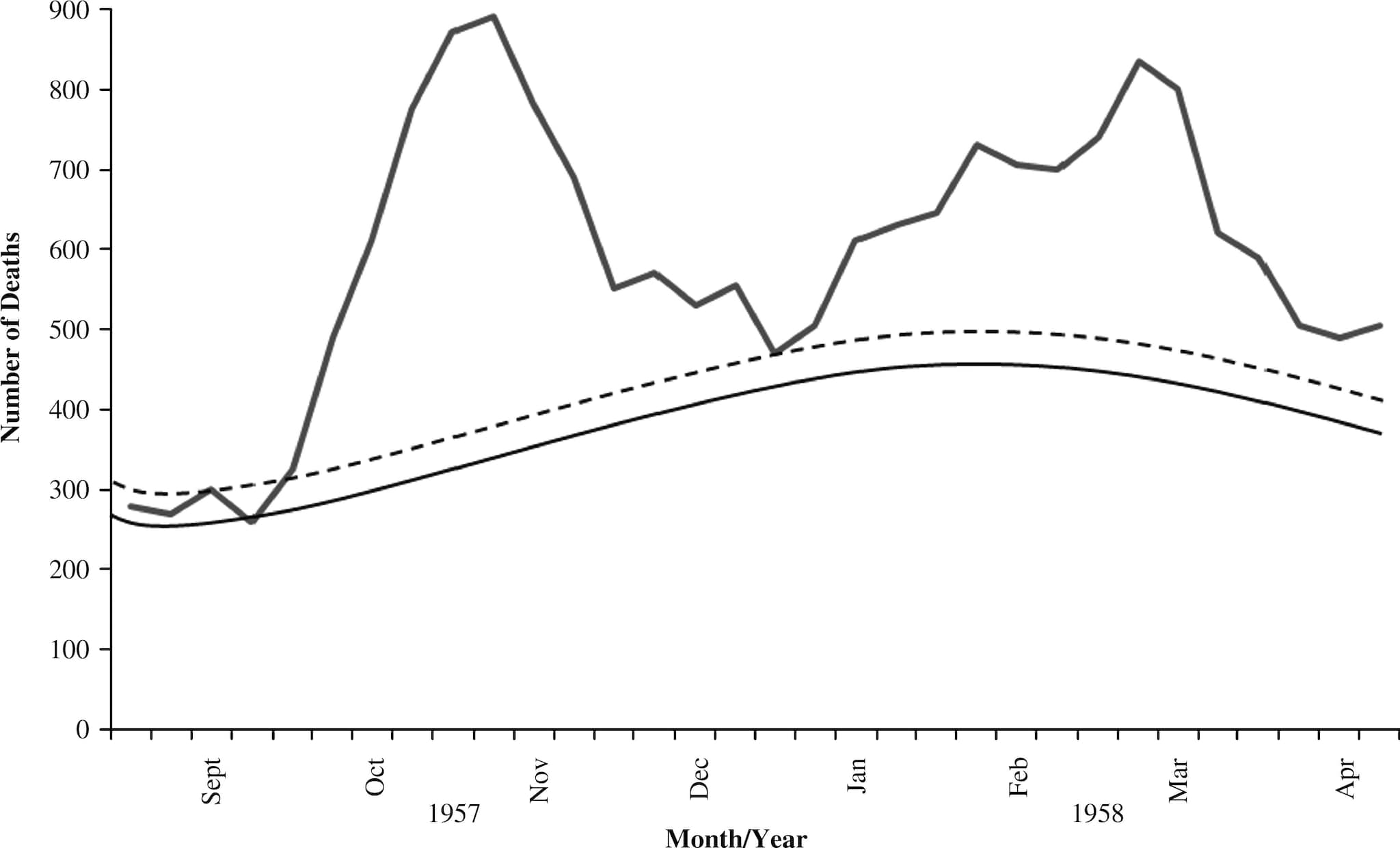
The CDC is worrying about a growing complacency among the public. To illustrate the need for continued vigilance and immunizations, she showed this graph (also reproduced below) mapping the deaths from the 1957 influenza activity. You’ll note there was an initial wave in fall 1957, followed by a lull in which deaths decreased, and then a resurgence in which the number of deaths peaked in March 1958, close to the level in the first wave.

Hit it while it’s down. According to Schuchat, the lull (where we currently are) “essentially gave the all-clear whistle in that [1957] December/January time period.” “They had vaccine,” she noted, “but they didn’t encourage its use.” For now, she said, the message is this: “The illness is down.  There’s plenty of vaccine.  It’s a key window of opportunity. We don’t want to repeat the story from 1957.”

Nuff said.

CDC Guidance for Nurses on the Swine Flu


Photo by AlphaTangoBravo/Adam Baker, via Flickr. Photo by AlphaTangoBravo/Adam Baker, via Flickr.

The following comes to us from the Centers for Disease Control and Prevention (CDC):


Swine Flu Guidance for Clinicians & Public Health Professionals [as of April 29, 2009, 1:45 AM ET]
http://www.cdc.gov/swineflu/guidance/
Clinicians should consider the possibility of swine influenza virus infections in patients presenting with febrile respiratory illness. If swine flu is suspected, clinicians should obtain a respiratory swab for swine influenza testing and place it in a refrigerator (not a freezer). Once collected, the clinician should contact their state or local health department to facilitate transport and timely diagnosis at a state public health laboratory.

Interim Guidance for Clinicians on Identifying and Caring for Patients with Swine-origin Influenza A (H1N1) Virus Infection [as of April 29, 2009 2:00 AM ET]
http://www.cdc.gov/swineflu/identifyingpatients.htm
Interim guidance is provided here for nurses and clinicians who might provide care for patients with swine-origin influenza A (H1N1) or suspected swine-origin influenza A (H1N1) virus infection. It will be periodically updated as information becomes available.

Transmission
Transmission of swine-origin influenza A (H1N1) is being studied as part of the ongoing outbreak investigation, but limited data available indicate that this virus is transmitted in ways similar to other influenza viruses. Seasonal human influenza viruses are spread from person to person primarily through large-particle respiratory droplet transmission (e.g., when an infected person coughs or sneezes near a susceptible person). Transmission via large-particle droplets requires close contact between source and recipient persons, […]

Go to Top