2010: The Year of the Nurse

By Shawn Kennedy, interim editor-in-chief

Tomorrow when we ring in the New Year we’ll also be ringing in the International Year of the Nurse. No kidding. The designation honors the centennial of the death of Florence Nightingale (she died on August 13, 1910). It launches at noon everywhere on January 1 with the Million Nurse Global Caring Field Project, a “global meditation” led by noted nursing theorist Jean Watson, and events will continue throughout the year.

Most of you were probably aware that the United Nations had developed eight Millenium Development Goals (MDGs) that nations should achieve to end poverty and improve the health, education, and quality of life of their peoples. Three of the eight goals are specifically focused on health, but the others all have an impact on health one way or another.

The target date for achieving the goals is 2015, but as countries have implemented programs to achieve these goals they’ve become acutely aware that, without nurses in sufficient supply, they will fall short. For example, how do you reduce the maternal death rate during childbirth if there are few skilled health professionals to provide prenatal care or assist at births? How do you treat TB and HIV when there are no health workers to dispense and monitor drug therapy? […]

If Your Facility Were To Make a New Year’s Resolution, What Would It Be?


We asked the question “If your facility were to make a New Year’s resolution, what would it be?” on our Facebook page yesterday.

Below are some of the responses so far. Is there anything else you might add about your facility?


AMAZING HEALTHCARE

better patient care

maybe respect the staff

best patient safety

excellent mental/emotional health assessment and intervention

Every patient everytime!

i double that for respect for staff

It’s all about what’s best for the patients …

From my point of view….give us all a raise no matter how big or small!

Quality care, NOT Quantity care!!!

Free parking

Be COMPLETELY up on EMR by year end

To get the Drs to improve upon their verbal and written communication to nursing staff and to improve Drs understanding of what is meant by palliative care.

Bookmark and Share

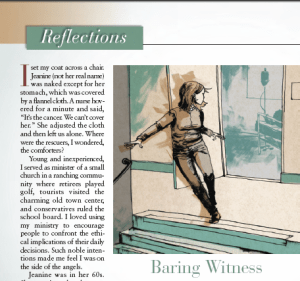
Different Gods, Different Ideas of Compassion: A Clergywoman’s Story of the Doctor Who Wouldn’t

Jeanine was in her 60s. She wasn’t a church member and I barely knew her. A neighbor had called me to the hospital-Jeanine’s husband was dead, and there were no family or friends at her side. Trying to get my bearings, I leaned over her and recited the words of the Twenty-third Psalm: “The Lord is my shepherd …. Yea, though I walk through the valley of the shadow of death, I will fear no evil ….”

“Help me,” Jeanine moaned. Her eyes opened and then closed. I knew she was pleading for release from her pain.

“Jeanine, I’m so sorry,” I whispered. I hurried to the nurses’ station. When a young nurse looked up, I asked if she could do more to relieve Jeanine’s pain.

“Nothing more to do,” she said, looking back down at an open ledger.

The above is an excerpt from the Reflections essay in the December issue of AJN. It’s by a retired clergywoman who tells of a moment early in her career that brought her face to face with a doctor who believed in a very different kind of God than her own. Click the link above to read the essay in entirety.  

Bookmark and Share

2016-11-21T13:20:26-05:00December 23rd, 2009|Nursing|0 Comments

Helping Nurses Overcome Barriers to the Baccalaureate

By Shawn Kennedy, MA, RN, interim editor-in-chief

It’s not always easy for a nurse with an associate’s degree to obtain a baccalaureate. Many may have families to care for or support. Financial and time pressures can be considerable. The part-time community college model is great when it comes to obtaining the associate’s degree, but then many who want to advance find the door closed: they can’t afford the higher tuition at a local private school offering the baccalaureate, or they can’t travel from a rural community to an urban center where a city or state school is located, or they need to do a portion of their coursework on a part-time basis. With such barriers in place, how will we ever solve the nursing shortage?

These problems are being addressed. Last week I had the opportunity to speak with several faculty from the program in nursing at Queensborough Community College (QCC), City University of New York, including Tina Iakovou and Marge Riley, both assistant professors; Anne Marie Menendez, chair of the program; and Lucy O’Leary, a “student success advocate.” The meeting took place at the Hunter-Bellevue School of Nursing in New York City. Also present were Christine Tanner, a distinguished professor at Oregon Health and Sciences University (OHSU), and Marilyn DeLuca, formerly of the  Jonas Center for Nursing Excellence.

We were there to discuss the unique collaboration QCC has with Hunter-Bellevue, one based on a model developed by Tanner and colleagues in Oregon. Tanner […]

2016-11-21T13:20:31-05:00December 21st, 2009|Nursing|0 Comments

Psychodrama, and Dreams: Art of Nursing’s December Poet

By Sylvia Foley, AJN senior editor

“Wife two weeps, leaves a trail of tissues, // stamps her foot, cries no one loves her,“ reports the narrator of “Psychodrama Session.”  The poem, featured in this month’s Art of Nursing, offers a vivid look at what might happen when a man in psychotherapy talks about his past; read it here.  (You’ll need to click again on “Article as PDF.”)  Though her characters are imagined, writer Joan Mazza knows the world she’s writing about. She is a licensed psychotherapist and certified sex therapist as well as a speaker and writing coach.

Mazza has been published in numerous literary and mainstream magazines, from The MacGuffin and The Hudson Review to Writer’s Digest and, yes, Playgirl. She has also written several books on the uses of dreams, including Dream Back Your Life: A Practical Guide to Dreams, Daydreams, and Fantasies (Perigree Trade, 2000), described as a dream-based approach to self-improvement. For more information, visit her Web site.

And if you’re a poet or a visual artist, please consider submitting to Art of Nursing. Read this blog post for details. Guidelines can be found here; and if you still have questions, feel free to write to the Art of Nursing coordinator (me) at sylvia.foley@wolterskluwer.com.

Bookmark and Share

2016-11-21T13:20:33-05:00December 17th, 2009|Nursing|1 Comment
Go to Top